


AI is changing both how software is built and what QA teams must validate. This guide covers the five trends shaping software testing in 2026.
From evaluating AI applications to piloting testing agents, we share what we see in our projects and how to adopt each trend with clear goals, trained people, and the right controls.
TL;DR
- Test AI applications against business expectations, including variable outputs and unsafe actions.
- Review AI-generated tests for meaningful coverage before trusting their results.
- Introduce testing agents through bounded pilots with traceable execution.
- Build adoption around training, governance, and measurable quality outcomes.
What New Software Testing Trends Are Shaping QA in 2026?
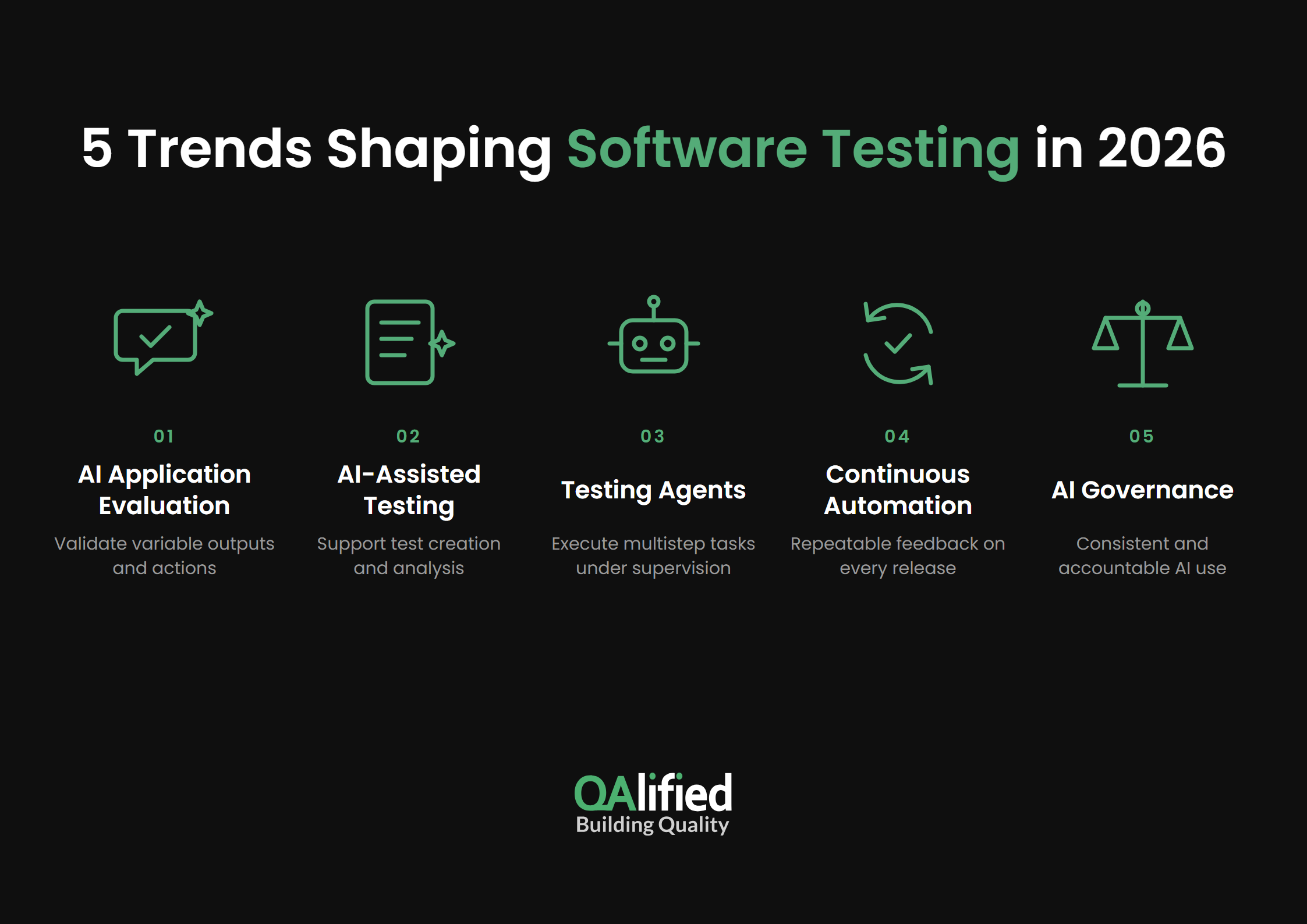
The leading trends in software testing for 2026 include evaluating AI applications, using AI to support testing, experimenting with testing agents, expanding continuous automation, and establishing AI governance. At QAlified, we see these changes increasing the importance of human judgment, realistic adoption plans, and collaboration across the software development lifecycle.
Why Is Software Testing Evolving in 2026?
Software testing is evolving because AI changes both how applications are built and what QA teams must validate. In our experience, release cycles are becoming faster and more frequent, while AI-assisted development adds pressure to provide timely feedback.
We also see companies seeking AI-powered testing before they have the foundations to use it effectively. A tool purchase needs a defined role in the software development lifecycle (SDLC), clear responsibilities, and people who can evaluate its output. The following trends address those practical challenges.
What Are the Latest Trends in Software Testing?
The latest trends in software testing combine established automation practices with emerging approaches to AI. Their maturity varies: continuous automation is established, while the extent of useful autonomy in testing agents still needs validation for each context.
1. How Is Testing AI Applications Changing Quality Validation?
Testing AI applications requires assessing whether outputs and actions meet business expectations across realistic scenarios. Large language models (LLMs) can produce different responses to similar inputs, so checking one expected answer provides limited evidence of reliability.
For a support assistant answering a refund question, QA should check policy compliance, the information used, and escalation when a request exceeds its authority. Anthropic’s guidance on agent evaluations explains how repeated trials and a combination of automated checks, model-based scoring, and human review help assess performance.
Security also belongs in the evaluation scope: OWASP’s prompt injection guidance describes how malicious instructions in user input or external content can alter model behavior. We recommend testing access boundaries alongside answer quality, particularly when an AI application can take actions.
2. Where Does AI Assistance Add Value to Testing?
AI assistance can support test design, script drafting, and investigation, provided QA professionals validate the suggestions. The useful starting point is a specific task with a clear quality standard, such as drafting scenarios from acceptance criteria for review.
Among the new trends in software testing, AI assistance makes critical thinking more valuable. We emphasize the difference between asking AI for output and adding value as a tester. Copying a generated test without checking its assumptions can preserve misunderstandings found in the implementation. We recommend reviewing assertions, missing negative scenarios, and business rules before adding generated tests to a suite.
3. What Can Testing Agents Do Under Human Supervision?
Testing agents can combine multiple actions, such as navigating an application, running checks, and collecting evidence. Their ability to choose subsequent actions makes them different from a script that follows a predefined sequence.
We recommend a bounded pilot with permitted actions, stopping conditions, and reproducible evidence before expanding autonomy. An agent could explore a test environment using synthetic accounts and report suspected failures for human review. An agent’s completion message is insufficient proof of success: Anthropic’s evaluation guidance distinguishes the execution trace from the final state, so a claimed successful checkout should be verified against the order actually created. Testing agents remain an emerging practice whose reliability depends on the task and controls.
4. Why Is Continuous Automation Becoming More Important?
Continuous automation provides repeatable feedback as development and release cycles accelerate. We see technical barriers to automation decreasing, making more scenarios practical to automate.
We recommend prioritizing stable, repeatable checks around critical business journeys, then integrating those checks into the delivery pipeline. A suite with frequent false failures can delay decisions and weaken confidence. Our Automation Testing Service helps teams develop and maintain automated testing. AI support should complement a clear automation strategy with defined coverage and ownership.
5. Why Is AI Governance Becoming Part of QA Practice?
AI governance defines how teams use AI, who remains accountable, and which controls apply. We consider a clear roadmap, achievable objectives, expert support, and shared rules prerequisites for adoption. We recommend documenting approved use cases, data handling rules, review responsibilities, and escalation paths. Expectations also need realistic timelines because learning and integration take sustained effort.
At QAlified, we have encouraged AI use systematically through training, methodological frameworks, and support for our team. We are approaching adoption carefully while adapting testing to changes in software development. The process gives testers guidance beyond access to an AI tool. The comparison below summarizes the purpose and main adoption challenge of each trend.
| Trend | Main purpose | Main adoption challenge |
|---|---|---|
| AI application evaluation | Validate variable outputs and actions | Define meaningful quality criteria |
| AI-assisted testing | Support test creation and analysis | Review assumptions and coverage |
| Testing agents | Execute and investigate multistep tasks | Verify actions and outcomes |
| Continuous automation | Provide repeatable release feedback | Maintain reliable tests and environments |
| AI governance | Guide consistent and accountable use | Sustain training and ownership |
How Are Recent Trends in Software Testing Changing the QA Role?
The recent trends in software testing shift QA work toward evaluating evidence, identifying overlooked risks, and deciding where automation is useful. We anticipate that AI could enable smaller, broader-skilled teams to create and maintain tests with less effort. Human judgment remains essential for identifying unexpected scenarios and raising alerts before failures reach users.
The skills we recommend developing include:
- Critical evaluation: challenge AI-generated scenarios and recognize unsupported conclusions.
- Technical understanding: investigate failures across APIs, data, integrations, and interfaces.
- AI evaluation: define scoring criteria and assess variable behavior.
- Business judgment: connect defects to user impact and release decisions.
We see a need for closer collaboration among development, QA, security, and operations. Shared quality goals help teams assess whether faster development produces a robust product that serves end users.
How Can QA Teams Prepare for the Future of Software Testing?
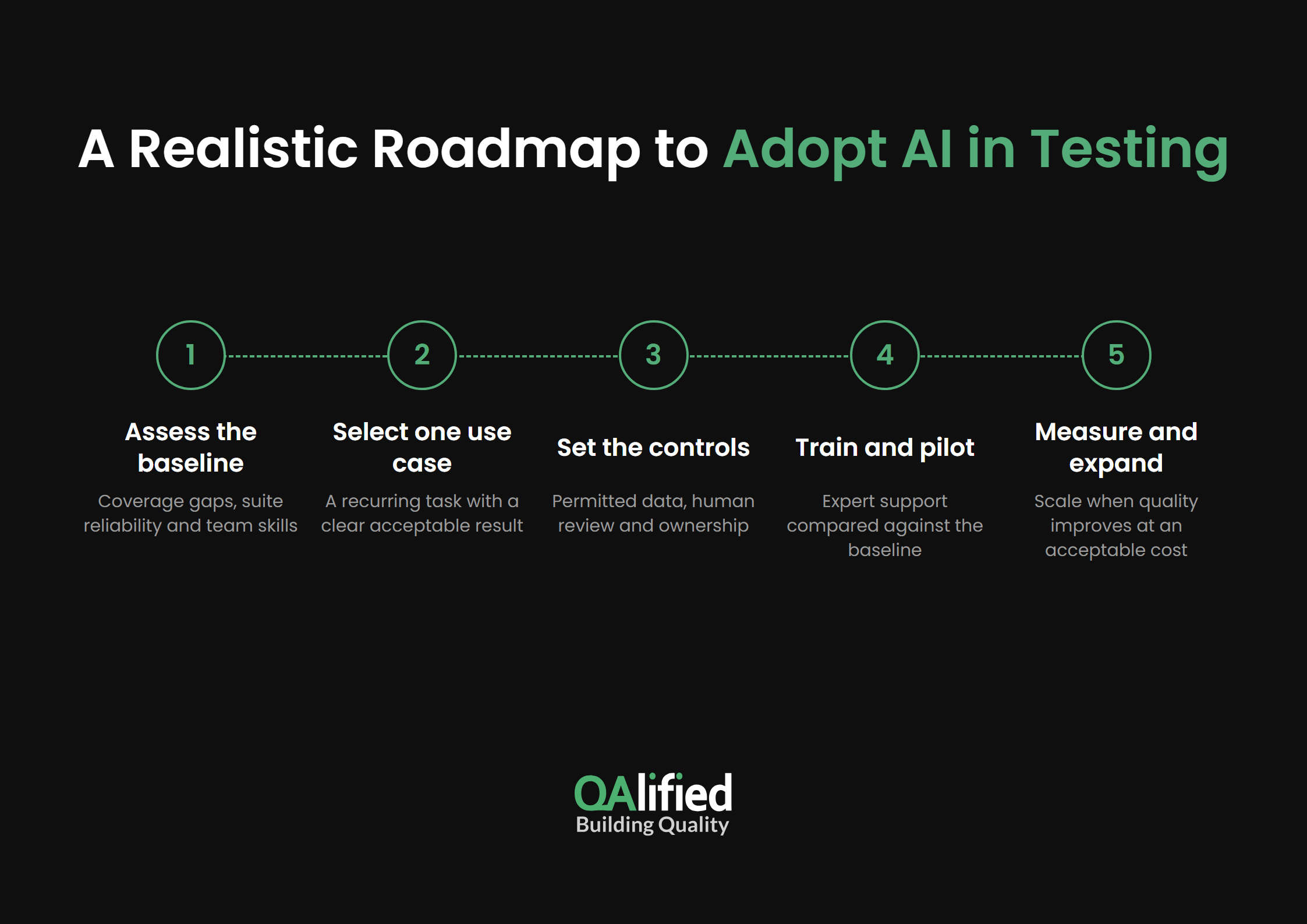
QA teams should prepare through a realistic adoption roadmap with defined ownership and measurable objectives. We recommend the following sequence:
- Assess the baseline. Review coverage gaps, suite reliability, team skills, and current feedback times.
- Select one use case. Choose a recurring task and define what an acceptable result looks like.
- Set the controls. Establish permitted data, human review, and responsibility for failures.
- Train and pilot. Provide expert support and compare the new workflow with the baseline.
- Measure and expand. Scale when results demonstrate useful quality improvements at an acceptable cost.
Record the approach in your software test plan, including scope, environments, responsibilities, and acceptance criteria. A documented plan makes adoption easier to review and repeat.
For the pilot, we recommend tracking time to actionable feedback, review and maintenance effort, false failures, critical-scenario coverage, and defects escaping into production. Compare equivalent workloads and record any change in scope before interpreting improvement. Faster execution is useful when the team can still trust the evidence behind a release decision.
Build a Future-Ready Software Testing Strategy with QAlified
The most useful response to software testing trends is a strategy that strengthens quality in your own development process. AI evaluation, assisted testing, and automation need clear objectives, trained people, and evidence that the approach works.
At QAlified, we combine our testing perspective with a systematic approach to AI adoption. Explore our Software Development & Tech Testing Services to discuss how we can help you build a QA strategy that supports reliable releases and your team’s next stage of growth.
SHARE:
