


With increasing complexity of software systems and the shrinking delivery cycle, traditional testing methodologies struggle to keep pace with the speed and precision. In high-stakes environments where system failures can lead to revenue loss, safety issues or compliance problems, QA teams need smarter, risk-aware strategies.
Risk-Based Testing (RBT) is a data-driven approach that aligns test coverage with business priorities by quantifying failure likelihood and consequences. Despite limited resources and time, it helps teams identify and address high-risk areas early in the lifecycle.

RBT helps to communicate risk exposure and coverage gaps transparently to stakeholders and make informed decisions. RBT is more than a test methodology, it’s a way of operating in uncertainty in modern software development.
This guide discusses Risk-Based Testing (RBT), its uses, implementation, main risk types, methods, measures, benefits, challenges, solutions, and FAQs.
What is Risk-Based Testing (RBT) and when is it necessary?
Risk-Based Testing (RBT) is a structured, iterative testing methodology in which test activities are prioritized and tailored according to quantified risk levels. It is closely connected to the entire QA lifecycle, starting with the requirement analysis and continuing with the test case design, execution, and reporting.
RBT determines the high-risk areas based on a variety of data sources such as historical defect density, code churn, static analysis results, or change frequency scores. Modules that are difficult to test, break often during integration, or have external dependencies are given more risk.
The risk assessment methods, such as Failure Mode Effects Analysis (FMEA), risk trees, and hazard analysis, measure and classify risks both at the functional and technical levels. Risk-based traceability matrices map risk items to test cases, so that high-risk failure modes are covered early.
RBT includes fault injection, boundary value testing, stress testing, and exploratory testing to maximize defect detection in sensitive areas. Quantitative measures such as risk-adjusted coverage, risk burn-down rate, and residual risk percentage help teams track risk mitigation over time.
This approach is vital in Agile and DevOps, where regression isn’t possible because of short iterations. It is also important in regulated fields like healthcare, finance, and automotive, where failures can go unnoticed but cause legal issues, financial loss, or injury.
Types of Risk-Based Tests
In software testing, a risk is defined as any situation that could cause system failure, performance degradation, or business interference. RBT determines product risks and project risks and maps them to the intended test activities.
A complete risk taxonomy provides a full-spectrum coverage of functional, technical, and operational areas. Let’s have a look at the types of risk-based tests:
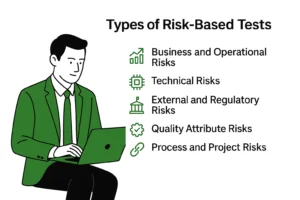
Business and Operational Risks
These risks relate to the potential impact of system failure on business operations and end-user functionalities. Workflows like e-commerce checkout, banking transactions, or airline booking systems can be considered as business or operational risks.
RBT prioritizes these aspects based on usage frequency, transaction value, and SLA. Traceability matrices connect the business risks with user stories, acceptance criteria, and risk-weighted test cases.
Technical Risks
Technical risks arise from the complexity of code, architectural design, or technological limitations. The use of asynchronous workflows, complex data transformations, or distributed services can pose a potential risk.
These risks are mitigated by static code analysis, integration testing, mutation testing, and component-level fault injection.
External and Regulatory Risks
These are legal (General Data Protection Regulation (GDPR), Health Insurance Portability and Accountability Act (HIPAA), Payment Card Industry Data Security Standard (PCI-DSS)), third-party dependencies, and vendor service agreements. RBT requires security testing (Static Application Security Testing (SAST) / Dynamic Application Security Testing (DAST)), audit trail checks, and contract-based testing for external APIs.
The areas of regulatory risks are outlined with the help of compliance checklists and implemented through policy-based test automation. Third-party failure scenarios must be tested, and this requires the availability of mocks or sandbox environments.
Quality Attribute Risks
RBT uses strict validation on the non-functional dimensions in which failure affects the quality of the system. These include:
- Performance risk: Modules with high data throughput are tested under load, stress, and spikes.
- Security risk: Vulnerability scans and penetration testing are done at the authentication, authorization, and data flow levels.
- Usability risk: Accessibility and user experience testing concentrate on high-traffic UI flows.
These tests are risk-scored and prioritized in CI pipelines according to deployment-criticality.
Process and Project Risk
RBT process risks include shortened cycles, unstable environments, incomplete requirements, and tooling gaps. With tighter constraints, tests are re-prioritized by risk score and limited to the highest-risk features, typically the top quartile per risk-based testing guidelines.
Lower-risk tests are delayed or done with quick checks and automation to maximize efficiency. Interactive dashboards help stakeholders decide go/no-go by showing deferred tests and residual risk percentages.
Step by Step: Risk-based testing done by QAlified
QAlified delivers a disciplined, four-step RBT process to align QA effort with the features that present the highest business and technical risk. The process is as follows:
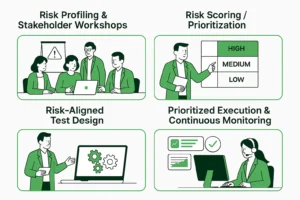
Risk Profiling & Stakeholder Workshops
The work began with a series of collaborative workshops with QA leads, professionals, product managers, and developers. They modeled the functional landscape and identified high-risk areas like EHR access rights, refund process, and the stability of the insurance API.
QAlified helped develop an official risk register, evaluating each area by volatility, defect history, business impact, and data sensitivity.
Risk Scoring / Prioritization
QAlified used a quantitative model to score the risk items, considering the likelihood of failure, the impact severity, and architectural complexity.
Visual risk matrix categorizes modules as High, Medium or Low risk.Core systems are given High priority.
Risk-Aligned Test Design Data Strategy
The risk tiers are established and QAlified developed test cases according to the risk exposure. Components with high risks are subjected to state-transition modeling, boundary-value testing, and exploratory testing.
In order to be HIPAA compliant, synthetic data simulates real-world scenarios while protecting PII. Each test case identifies and tracks the original risk items, therefore making it fully auditable.
Prioritized Execution & Continuous Monitoring
Measures such as risk-weighted coverage, critical defect discovery rate, and defect escape rate are continuously monitored through dashboards. The smoke or sanity tests are performed on low-risk modules, such as UI customization, to achieve a minimum level of stability without excessive investment.
Techniques and metrics
Techniques
RBT uses analytical methods and precision measures to target key failure conditions. Let’s look at some of the techniques and metrics for this purpose:
Boundary-Value Analysis (BVA)
Boundary-Value Analysis (BVA) aims to identify logic errors at boundary values, such as minimums, maximums and off-by-one values. In RBT, it is necessary to validate modules that handle the credit limit, temperature tolerances, timeouts, and pagination offsets.
QA teams that use BVA on financial, embedded, and telemetry systems make sure that edge conditions that cause branching logic or overflow/underflow hazards are exercised.
Pairwise Testing
Pairwise testing decreases the number of test cases by covering all combinations of input parameters at least once in pairs. It is useful in systems that require a lot of configuration (e.g., cloud provisioning portals, UI localization settings, multi-OS support).
High-impact combinations (e.g., browser type + feature flag + auth level) are tested more extensively when the risk scores are mapped onto them.
State Transition Testing
This method models the system under test as a finite-state machine (FSM) and tests transitions between states. RBT can use this to verify risky workflows like order processing, user sessions, or incident lifecycle changes.
The test coverage encompasses valid, invalid, and edge transitions (e.g., trying to cancel the orders that were already completed). Critical transitions (e.g., between authorized and settled in payments) are provided with exhaustive transition-path coverage when combined with risk matrices.
Exploratory Risk Tours
Risk-based exploratory testing is carried out using risk heuristics. Charters are risk-based, and testers conduct a kind of tour of critical areas of the system, such as payment logic or admin features.
These sessions reveal underlying state problems, context-related failures, and inconsistencies in behavior that scripted tests overlook. Used with logging, instrumentation, and session recording, it effectively identifies context-sensitive defects in high-risk modules under time constraints.
Risk-Based Test Prioritization (RTP)
RTP is a process of prioritizing test cases based on structured scoring formulas, which are generally qualitative or quantitative measures of likelihood, impact and detectability. It is conducted in a repetitive manner during test planning and is revised continually by defect analytics and change impact analysis.
Weighted Risk Index (WRI) or Decision Tables techniques assign risk values to the order of test execution. RTP guarantees that the most risky areas are tested in the first builds, especially relevant to CI/CD pipelines.
These techniques not only help identify defects in high-risk areas, but they are also evaluated using specific metrics that measure the effectiveness of Risk-Based Testing (RBT).
Metrics
Risk Coverage (%)
Risk Coverage is the percentage of high/medium risk items with related test cases that are executed. The metric makes risk items (Risk Breakdown Structure or RBT matrix) traceable to actual test artifacts. It is determined by:
Risk Coverage = [(Tested Risk Items / Total Identified Risk Items) x 100]
Defect Density
Defect Density determines the location of defect hotspots and evaluates the effectiveness of risk at the component level. It is estimated as:
Defect Density = (Confirmed defects / component size) * Scaling factor
Size is usually in KLOC, function points, or feature complexity score. The modules that have had high defect densities in the past are marked as high-risk modules in subsequent iterations.
Risk Burn-Down Rate
Risk Burn-Down is a visualization of the reduction of the amount of unresolved or untested risks over a project timeline (e.g., sprint, release, or PI). It is traced by QA teams through a cumulative exposure score per iteration. The measures are open risk count, average severity, and risk score deltas.
Test Effectiveness Index (TEI)
TEI determines the effectiveness of the test set in reducing risk and defect leakage. It incorporates:
- Risk Coverage
- Efficiency of Defect Detection
- Severity Distribution of Found Bugs
TEI = (High Severity Bugs Caught Pre-release / Total High Severity Bugs) x Risk Coverage Weight
A large TEI indicates that QA is concentrating on significant failures. This feedback loop refines risk definitions, guides future test design, and continuously sharpens overall QA strategy.
Through the systematic implementation of these sophisticated methods and measures, RBT makes QA a data-driven, constantly evolving process. It ensures high-risk areas are tested early and thoroughly despite tight schedules or shifting priorities.
Benefits of RBT
Now, let’s examine the core benefits of Risk-Based Testing:
- Early Detection: RBT prioritizes test coverage to modules with a high likelihood and impact of failure. Prompt resolution of issues reduces the cost and feedback loops in CI/CD pipelines.
- Increased Risk Visibility: Traceability matrices or risk-weighted coverage maps each test case to the applicable risk factors. This evidence-based perspective aids in making informed decisions about releases and alignment of stakeholders.
- Agile-Compatible and Adaptive: RBT focuses on dynamically testing changes in response to new threats, changes, or dependencies. Enables quick delivery without compromising quality in dynamic Agile environments.
- Optimized Coverage of Tests: Testing focuses on execution paths that are risk-scored, weighted, and prioritized. This reveals edge cases, concurrency bugs, or state-dependent failures, which are easily overlooked in blanket coverage.
- Business Alignment: RBT ensures that features associated with SLAs, regulatory compliance, or user trust are given the highest test depth. Risk scoring demonstrates business impact rather than technical complexity.
Challenges and their solutions
Although RBT offers key benefits for improving system quality, it also comes with challenges. Here’s a concise table summarizing the key challenges and their solutions in Risk-Based Testing:
| Challenge | Description | Solution |
| Ignoring Low-Risk Areas | RBT often overlooks low-risk modules, leading to unnoticed defects in secondary but user-visible components. | Apply baseline sanity/smoke tests to all features. Use time-buffered testing tiers to extend coverage after high/medium-risk areas are validated. |
| Risk Assessment Subjectivity | Risk prioritization can be skewed by personal judgment or lack of data, reducing accuracy. | Use multi-role reviews involving QA, developers, and business analysts. Apply historical defect analytics and structured techniques like the Delphi method for objectivity. |
| Agile High Maintenance | Rapid iterations make static risk models obsolete, requiring continuous updates that can become overhead. | Integrate risk reviews into sprint cycles. Use flexible test tagging based on risk level to allow real-time adjustments during planning and retrospectives. |
| New or Unknown Domains Inapplicability | Without prior domain experience, assessing risk at the start is speculative and error-prone. | Perform exploratory testing early to uncover unknown risks. Build an iterative risk model that evolves with product knowledge. |
| QA Team Skill Gaps | Lack of technical depth or domain understanding can hinder effective RBT execution. | Offer architecture and domain training, involve subject matter experts, and create reusable risk catalogs for consistent onboarding and decision-making. |
Conclusion
Risk-Based Testing (RBT) transforms quality assurance by swapping comprehensive, low-value testing with risk-based approaches. This is a method that yields quantifiable benefits in efficiency, test coverage, and early risk mitigation in fast-paced or high-risk environments.
RBT is not only a testing technique but a strategic approach to software resilience and release certainty when used cooperatively and sustained.
Key Takeaways
- RBT focuses QA efforts on the riskiest areas to improve defect detection where the failure impact is high.
- It works well with Agile, allowing dynamic prioritization of tests in rapidly changing environments.
- The approach minimizes time-to-market by eliminating redundant testing and targeting critical paths.
RBT increases efficiency and quality by integrating deep validation with lightweight coverage of low-risk features. To maximize RBT’s effectiveness, consider using the services of a dedicated QA partner that provides project-based testing services.
QAlified has extensive domain knowledge, techniques and practical experience that can help you incorporate RBT into your QA lifecycle, including risk modeling and automated testing. Let QAlified lead your teams for smarter testing, quicker delivery, and more robust software.
FAQs
1. What are the ways of identifying risks in RBT?
The risks are identified in a collaborative manner through checklists, past defects data, dev, QA, and business team input. They are scored as impact x likelihood in order to prioritize important areas.
2. What makes RBT different from traditional testing?
RBT prioritizes tests based on quantified risk rather than feature lists or specifications. Unlike traditional static test plans, it adapts dynamically as risks change.
3. Is RBT compatible with other tests?
Yes. RBT complements exploratory, automated, and BDD testing by guiding priorities. It acts as a prioritization layer that works with any methodology.
4. How do you manage changing risks?
Include risk reviews in each sprint planning or change request. Revise the risk register and adjust test priorities as new threats emerge.
5. How do you measure the success of the RBT?
Measure high-risk area coverage, severity-weighted defect escape rate, and residual risk at release. Risk burn-down charts assist in the visualization of testing progress relative to risk exposure.
SHARE:

