


Today's tech companies gain a competitive advantage from fast software delivery without sustaining system failures.
Systematic regression testing serves as a method to verify that the new code does not impact on the existing features, which enables companies to scale software delivery with confidence.

An efficient implementation of regression tests detects issues early, protecting both reputation and revenue. Disruptions to existing functionality often cause more harm than the benefits introduced by new features. Every Windows OS user would still be remembering the October 2018 Windows 10 update. The patch was intended to free disk space, but it deleted user files because regression tests failed to detect the modifications.
This blog assists technology leaders in establishing a solid automated regression testing framework through Selenium, Appium, Cypress, and Playwright tools while offering practical guidance for sustaining and improving their regression test suites across time.
Why leaders should care about regression testing
When developers modify their code, they introduce the possibility of disrupting current system functionality. The execution of complete automated or manual regression tests enables multiple benefits in the following ways:
- Regression testing serves as a protective shield for customers. It finds problems before product deployment to prevent feature failures and user dissatisfaction that harm brand standing.
- Frequent deployments become possible when teams maintain confidence that new code changes will not disrupt existing functionality.
- The deployment confidence system provides developers with a safer environment for making modifications, as the system will catch unintended side effects of their changes.
- Through the automation of testing repetitive workflows and capabilities, test engineers can perform exploratory testing, usability assessments, and other essential activities that require human decision-making.
- Executives and technology leaders who implement effective regression testing produce fewer embarrassing outages. This enables faster product release cycles and more efficient utilization of the engineering team, which leads to higher customer satisfaction.
Regression test maintenance process
Long-term success depends heavily on proper regression test maintenance, which most organizations fail to address adequately. A regression test pack requires regular maintenance to avoid becoming a slow and unreliable testing system. A planned test maintenance process helps ensure that your regression test assets remain valuable.
The test case life cycle
Regression test cases experience a lifecycle that starts at the time of new functionality development before progressing through multiple stages.
- New enhancement development: A feature or change is identified and implemented
- Project test case creation: The testing team develops test cases to verify the new functionality
- Test case maintenance process: The existing regression test cases undergo review and optimization
- Integration into the regression suite: The final step includes approved test cases becoming part of the permanent regression testing repository
Regression test case selection process
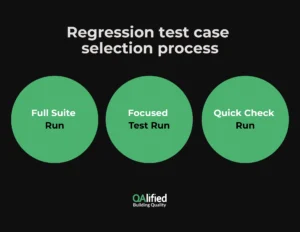
Different test selection strategies must be employed based on the specific situation:
Full Suite Run: A complete test suite should be retested whenever there are essential changes to:
- Technology stack
- Hardware or software platforms
- Significant changes to the database schema and backend systems
- Significant enhancements that affect many system workflows and capabilities
Focused Test Run: Select tests that modify the components or those whose output is influenced by the change. Appropriate for:
- Small to medium enhancements
- Third-party integrations
- Targeted feature updates
Quick Check Run: Select the minimum set of tests that verify affected components, practical after:
- Service pack releases
- Minor patches
- Small configuration changes
Managing the regression test suite
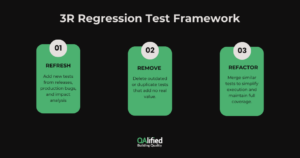
A healthy regression suite requires continuous refinement through three key processes:
Refresh -Adding Test Cases
New test cases should be added to the regression suite from:
- Previous Release Enhancements: Critical test cases from recent projects should be identified and included, with clear documentation of:
– Project name and ID
– Project description
– Impacted system components
– Test case details and storage location
- Production Defect Fixes: Tests that verify fixes for high-severity production issues should be prioritized for inclusion, especially for Severity 1 and 2 defects
- Current Release Impact Analysis: Tests for areas affected by current development work should be identified through collaborative analysis between development and testing teams
Remove – Purging Test Cases
Regular removal of unnecessary tests keeps the suite manageable:
- Performance-Based Purging: Remove or reduce tests for components with consistent 100% pass rates across multiple releases when recent changes don’t impact those areas
- Redundancy Elimination: Remove duplicate test cases that verify the same objectives, replacing older tests with newer, more comprehensive versions that cover the same functionality
Refactor – Merging Test Cases
Consolidation improves efficiency while maintaining coverage:
- Test Objective Analysis: Identify test cases with similar objectives
- Consolidated Test Design: Merge test steps from multiple cases into a comprehensive test
- Coverage Verification: Ensure the merged test case maintains full coverage of all original objectives
Organizations can maintain an efficient, effective regression test suite that evolves alongside the application by implementing this structured maintenance approach.
Picking testing tools that make sense
Your choice of testing tools should match your product, development methodology, and team skills. Here’s a detailed breakdown of four popular options:
A. Selenium & Appium: For testing many browsers and mobile devices
Selenium WebDriver has become the industry standard for cross-browser web application testing. It provides a unified API that works with many programming languages and integrates with most development ecosystems. Appium extends this capability to mobile applications on both Android and iOS platforms.
These tools work best when:
- Your application must function across multiple browsers, operating systems, and device types
- Your team has expertise in Java, Python, C#, or other supported languages
- You need to implement complex testing workflows with custom automation approaches
- You require integration with existing test management or continuous integration systems
B. Cypress: For JavaScript Apps and quick results
Cypress has gained popularity for testing modern web applications built with React, Angular, Vue, and similar frameworks. Unlike traditional tools, Cypress runs directly in the browser, providing immediate visual feedback and simplifying debugging.
Choose Cypress when:
- You need rapid feedback during UI development and testing
- Your tests must be carried out in a headless environment for CI/CD pipelines
- Your development team works primarily with JavaScript/TypeScript
- You value developer experience and easy debugging over cross-browser compatibility
C. Playwright: For fast, multi-browser testing
Microsoft’s Playwright provides reliable automation for Chromium-based browsers, Firefox, and Safari. It’s designed for modern web applications and offers auto-waiting, network interception, and mobile emulation capabilities. The tool delivers its best results under the following conditions:
- Safari plays an essential role in your testing because your users primarily use this browser
- Your test automation requires consistent execution for multiple user interactions, including drag-and-drop functionality and file upload operations.
- Executing tests in parallel is essential to achieve faster overall test execution times.
- When your testing needs include both API testing and mocking, and UI testing capabilities
Several organizations follow a mixed strategy, using Selenium for older systems, broad compatibility, and Appium for mobile applications while utilizing Cypress or Playwright for contemporary web development, which values developer experience alongside test reliability.
Practical approaches to ui and api testing
The regression suite requires a balanced approach that combines UI testing with API testing to fulfill different purposes.
UI testing best practices
The process of UI testing performs simulations that mimic how users interact with your application through its user interface. To maximize their effectiveness:
- Your automation efforts should target essential user journeys, such as registration, authentication, core transactions, and account management, instead of trying to automate everything on the UI.
- Select reliable element selection methods using data-test attributes and other stable identifiers instead of CSS classes or XPath selectors, which may change when designs update.
- The Page Object Model pattern should be implemented to improve maintainability. It creates abstraction layers representing pages or components, separating test logic from UI element interactions.
- Design each test to function independently instead of creating test sequences that need previous state dependencies, making diagnosing failures more difficult.
- The test coverage should be optimized to include only strategic browser and device combinations from your user analytics instead of testing every possible browser-device pair.
When you implement effective UI testing, your application’s expected user experience remains stable during code changes, particularly for essential features that your customers frequently use.
API testing best practices
The API testing approach provides better stability, together with faster execution speeds when compared to UI testing. Service integrations, together with business logic, need verification through API testing:
- Your testing efforts should begin with business-critical services that include authentication, payments, data persistence, and other fundamental business functions, which could result in significant issues if they fail.
- The testing should include both typical success cases and error scenarios because successful operations and proper error handling need verification and edge cases that could occur in production.
- Store environment-specific settings like endpoints and credentials in separate configuration files to enable test portability between environments.
- Specialized API testing tools such as Postman, REST-Assured, and Karate should be used because they help build requests, validate responses, and structure tests.
The service-level verification of core functionality through API tests provides a stable safety net that remains intact when the user interface changes.
Optimizing Your Regression Testing Effort
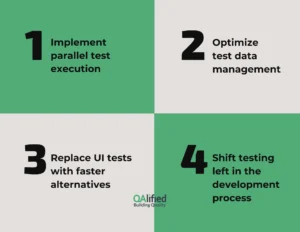
The testing team should focus on analyzing the results of regression tests after every release and spend time optimizing the process and approach. A few best practices are below:
- Implement parallel test execution: Configure your test automation framework and infrastructure to run multiple tests simultaneously, dramatically reducing overall execution time.
- Optimize test data management: To reduce setup time between tests, use shared test fixtures, containerized databases, or data generation tools.
- Replace UI tests with faster alternatives: Replace time-consuming UI tests with API tests or unit tests, maintaining the same verification goals.
- Shift testing left in the development process: Catch issues earlier by integrating more testing into development activities rather than waiting for dedicated QA cycles.
This optimization cycle should be a regular part of your testing practice, not a one-time effort.
Connecting Automated Regression Tests to Your DevOps Pipeline
Tests provide maximum value when they run consistently and deliver clear, actionable information. Testing should be integrated with your development and deployment pipeline to support progress rather than hinder it. The World Quality Report 2024 states that 75% of organizations identify Agile team quality delivery as essential through automation integration with CI/CD.
Quick Tests vs. Complete Tests
- Develop an automated regression testing approach with multiple levels to achieve both quick results and complete coverage.
- Run critical path tests (smoke tests) whenever code changes to verify that basic functionality works correctly, quickly.
- Schedule complete test suites to run overnight or before releases, executing tests in parallel to minimize total execution time.
- Implement intelligent test selection to run only the tests affected by specific code changes. Platforms like Tricentis SeaLights and Launchable provide impact analysis and AI based test selection features.
Using Tests to Control Releases
Test outcomes should be directly used in your release decisions:
- Configure your pipelines to prevent releases and deployment when critical tests fail
- Establish clear pass/fail criteria that teams understand and respect
- Create detailed, actionable reports so developers can quickly identify and fix issues
Regression Test Infrastructure That Works
Create a dependable infrastructure that supports your automated regression testing requirements:
- Use containerization or dedicated testing environments for consistent, reproducible test execution.
- Implement automation tools and frameworks that support parallel and distributed testing at scale.
- Implement detailed dashboards (like Allure or Report Portal) to make results visible and understandable to everyone.
- Track meaningful metrics, including pass rates, execution time, and coverage.
Key Takeaways on Automated Regression Testing
Modern software development requires automated regression testing, which separates successful engineering organizations from those that only respond to quality problems.
What to do next:
- Implement test automation tools that match your product, development methodology, and team skills.
- Define your regression maintenance process with designated ownership, specific selection standards, and periodic cleanup procedures.
- Document criteria around the selection of regression test cases based on the changes implemented in a release.
- Implement an automated regression testing strategy that includes UI tests to confirm user experience and API tests to validate backend reliability.
- Integrate automated regression testing into the CI/CD to identify problems at early stages.
When automated regression testing is fast, reliable, and integrated into your testing workflow, teams can deliver improvements quickly without sacrificing quality or confidence.
Ready to Strengthen Your Regression Testing Strategy?
Are you having issues in production because regression defects escape detection during your test cycles?
Is your team struggling to maintain your regression test pack as your application evolves?
Your organization needs a structured approach to decrease risks, save time, and maintain software stability. Implementing continuous automated regression testing provides protection for your core functionality and workflows throughout each release. Through an Automation Testing Service, QAlified can help you move from ad hoc testing to a structured, scalable regression assurance model that strengthens release confidence as your application evolves. Please reach out to us at info@qalified.com
References:
1. October 2018 Windows 10 Update Issues: https://blogs.windows.com/windowsexperience/2018/11/13/resuming-the-rollout-of-the-windows-10-october-2018-update/
2. World Quality Report 2024: https://www.capgemini.com/insights/research-library/world-quality-report-2024-25/
SHARE:

