


In the current digital landscape, applications are no longer just support systems — they’re the frontlines of customer experience, growth, and innovation.
Whether in banking, healthcare, or retail, the way organizations connect with users now hinges on seamless, high-quality digital interactions. Yet, many digital transformation efforts fall short — not because of a lack of vision, but because of poor execution.

To thrive in a landscape of rising expectations and constant change, companies must embrace digital assurance as a strategic imperative. For CXOs and founders, it’s the key to scaling reliably, protecting brand equity, and consistently delivering value at every user touchpoint.
Key Challenges in Digital Assurance
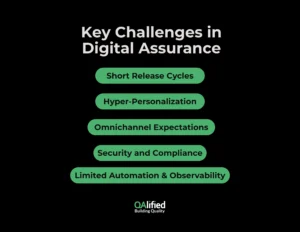
Organizations face several challenges related to testing digital applications. A few of the critical ones are listed below.
Short Release Cycles: The requirement for test readiness should match the delivery speed because organizations must deploy software weekly or biweekly. The delay of feedback creates problems for go-to-market strategies.
Hyper-Personalization: The banking and retail industries use algorithms to generate personalized offers, rates, and content for their customers. The testing process needs to validate different user personas and their respective contexts.
Omnichannel Expectations: Healthcare users can schedule appointments through mobile devices, manage prescriptions on web portals, and seek medical advice through kiosks. The absence of unified validation results in inconsistent user experiences across different platforms.
Security and Compliance: The healthcare industry must continuously validate HIPAA (Health Insurance Portability and Accountability Act) regulations, while the banking sector must test PCI-DSS (Payment Card Industry Data Security Standard) standards. Lack of coverage around compliance-specific scenarios often leads to audit risks and legal penalties.
Limited Automation and Observability: Digital assurance operates in a reactive mode instead of a predictive mode because it lacks automation and real-time feedback capabilities. The reactive approach increases the risk of releases and increases the cost.
The 10-Point Framework for Digital Assurance Success
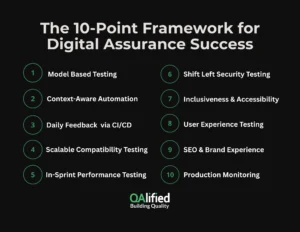
1. Model-Based Testing for Workflows
The testing team can visually create and validate essential business workflows, including banking loan processing, appointment scheduling in healthcare, and cart-to-checkout in retail through model-based testing. Digital assurance teams achieve complete test coverage through diagram-based process flow mapping, ensuring all rules, exceptions, and system integrations are included.
The method decreases redundant work while enhancing traceability and supporting fast business logic modifications. The technique most benefits systems involving multiple actors, including external APIs, front-end portals, and legacy databases. The visual representation of test journeys connects business stakeholders and QA teams, improving their collaboration.
2. Context-Aware Test Automation
The testing strategy adjusts its approach to use case requirements, channel needs, and risk levels. The testing requirements for healthcare integration APIs demand high priority, but UI automation has become essential for retail checkout page functionality. The automation strategy must handle different complexity levels, ranging from banking rule-based flows to healthcare conversational interfaces. The automated testing approach of contextual automation evaluates user characteristics, device patterns, and usage patterns to determine which tests need execution first.
Organizations achieve better test efficiency and reduced overhead while maximizing ROI through tool alignment between business objectives and automation techniques, which can be coded or codeless. The automated testing approach maintains resilience and remains meaningful and maintainable throughout digital assurance landscape developments.
3. Daily Feedback via CI/CD Integration
Integrating automated testing into the CI/CD pipeline lets teams verify code automatically for every commit or build, delivering immediate feedback to developers and QA professionals. The retail industry can detect checkout problems, which enable smooth promotion launches. Healthcare organizations benefit from workflow validation following each deployment to decrease the chance of errors affecting patients.
Digital assurance through CI/CD allows early defect discovery while shortening defect resolution times, creating a continuous quality culture. The process enables parallel testing execution and provides dashboards for better visibility, reducing human involvement. The result leads to expedited release cycles with improved standards and predictable market timelines.
4. Scalable Compatibility Testing
Delivering a consistent user experience requires comprehensive compatibility testing, as users interact with digital services through various browser combinations, device types, and network conditions. A banking user starts their loan application through a mobile browser before finishing it on a desktop. Healthcare patients use either old tablets or community kiosks to schedule teleconsultations.
Scalable compatibility testing executes tests through device labs combined with cloud-based farms and containerized environments to verify responsiveness and layout integrity while ensuring full functionality across different platforms. The practice cuts down customer service calls while boosting user adoption and maintaining equal digital access for all user groups with varying device capabilities.
5. In-Sprint Performance Testing
Each new feature must pass speed and scalability tests during sprint performance testing to validate its readiness. The retail promotion engine must handle high traffic spikes, while the healthcare booking portal requires immediate responses when multiple users access it simultaneously. Testing performance during sprint cycles begins with API benchmarks, which then develop into load and stress tests to prevent bottlenecks and latency problems before a system goes live.
The assessment focuses on four essential performance metrics: response time and throughput, CPU and memory utilization, and transaction concurrency. Integrating this process at an early stage of the lifecycle guarantees that systems maintain stability while being cost-effective and resilient in real-world operational conditions.
6. Shift-Left Security Testing (DevSecOps)
Security is a board-level concern. Embedding testing earlier in the SDLC (Software Development Life Cycle), known as shift-left, helps identify vulnerabilities before they reach production. This is especially critical for sectors handling sensitive data like banking credentials or patient health records.
Each development phase undergoes automated threat scanning through tools that perform static application security testing (SAST), dynamic application security testing (DAST), and software composition analysis (SCA). Organizations significantly reduce exposure risks by integrating these into CI pipelines and training developers on secure coding. Proactive security testing builds trust, ensures compliance, and minimizes expensive post-release remediation, making it a fundamental layer of digital assurance in regulated industries.
7. Digital Inclusiveness & Accessibility
Digital services must function for all users regardless of their visual, auditory, cognitive, or motor disabilities. Accessibility testing helps organizations meet WCAG (Web Content Accessibility Guidelines) standards while creating equal user experiences. Voice navigation and screen readers are essential tools for elderly banking users and patients who need to access their medical histories.
The testing process should confirm keyboard navigation functions correctly while also checking color contrast levels and ARIA (Accessible Rich Internet Applications) labels and error message clarity. The accessibility testing tool Axe detects standard accessibility problems, but human evaluation remains necessary for complex situations. Organizations focusing on accessibility fulfill their legal requirements while reaching new markets and building stronger public trust in their digital assurance platforms.
8. User Experience (UX) Testing
UX testing evaluates how intuitive and seamless an application feels to its users. It goes beyond functional checks to assess ease of navigation, visual consistency, and user satisfaction. In banking, users expect clarity around balances and transactions. The retail domain requires seamless product search and checkout functions. The UX testing process includes usability testing, heatmaps, A/B experiments, and user journey tracking.
The testing process should include visual testing to detect UI shifts, rendering issues, or layout inconsistencies across browsers and devices. The collected feedback enables teams to optimize layouts, user interface element positions, and workflow processes. A well-developed UX testing approach leads to better customer interaction while decreasing abandonment rates and boosting conversion metrics, enabling organizations to build stronger customer loyalty while differentiating themselves from competitors under digital assurance protection.
9. SEO & Brand Experience Testing
The success of digital visibility is dependent on SEO (Search Engine Optimization) performance and consistent brand experience. Testing verifies that page titles, metadata, schema markup, and mobile responsiveness follow search engine guidelines. The retail industry determines search result visibility through product page optimization.
Healthcare brand trust begins with URL cleanliness and fast-loading accessible content. The search engine rankings and credibility suffer when broken links, 404 errors, and duplicate content exist. A joint initiative between QA and marketing teams enables the verification of SEO hygiene, page analytics monitoring, and brand integrity maintenance across all user touchpoints, which are essential components of digital assurance.
10. Production Feedback & Monitoring
The actual monitoring phase starts when an application becomes available to users. Monitoring tools track users’ behavior while recording performance problems, crash reports, support ticket sentiments, and app review feedback. Fund transfer system failures in banking operations indicate problems with backend infrastructure. Healthcare systems experience login errors during peak hours, indicating session timeout defects.
Analyzing this data for regression testing and root cause analysis helps organizations make proactive quality improvements. The feedback loop between QA and operations becomes complete through monitoring, ensuring test priorities match the real-world impact. This process protects the digital brand by transforming reactive support into continuous digital assurance.
Conclusion
Digital assurance is a strategic growth accelerator for modern enterprises rather than an operational checkpoint. The quickening pace of product releases and user expectations for smooth experiences make a well-developed digital assurance strategy the key to market competition.
Leaders who implement this 10-point framework will achieve:
- Deliver reliable digital services.
- Reduce the cost of failure.
- Enhance brand equity
- Strengthening customer trust
Our team at QAlfiied uses digital assurance practices to ensure that your business-critical systems operate with high reliability, performance, and scalability across user journeys. We validate integrations, user interfaces, and backend workflows using advanced test automation, industry expertise, and continuous monitoring to protect against failures, security risks, and usability flaws.
Don’t wait for production issues to impact your brand or bottom line. Let’s build a digital assurance strategy that drives confidence, resilience, and growth.
SHARE:

