


Is your test cycle still stuck in the past, taking weeks to complete? If so, you're already behind. Modern enterprises require test cycles that are both agile and intelligent because speed meets compliance and experience. AI functions as the catalyst that transforms QA into a strategic engine that reduces testing duration from weeks to hours.
A slow test cycle threatens innovation, as agility is a key competitive advantage for software engineering leaders. AI technologies are transforming QA teams' testing practices to scale their work and achieve delivery goals.

This blog examines how AI-based solutions transform traditional QA practices into efficient, intelligent workflows that produce quicker releases, fewer bugs, and better business goal alignment.
What Are the Bottlenecks in Today’s Test Cycle?
Legacy test cycles were designed for development models that operated slowly. The current Agile, CI/CD and DevOps environment causes legacy test cycles to fail under stress. Here’s what typically holds teams back:
- The high frequency of UI changes causes automated scripts to break, which results in excessive test maintenance.
- Creating test data that meets compliance standards and appears realistic requires multiple days.
- The number of test cases grows over time, and many lack clear traceability.
- The manual testing process fails to detect visual defects when testing across different devices and browsers.
- Business teams face technical obstacles that prevent them from participating in the test execution activities.
Because of these issues, the development pipeline experiences increased time, cost, and friction. But now, there’s a more innovative way forward.
How Is AI Transforming the Software Test Cycle?
As per the World Quality Report 2024-25, 34% of organizations have already adopted AI-based solutions to improve software testing activities. The strategic usage of AI enables software testing teams to achieve better outcomes by multiplying their efforts. Let’s explore six AI-driven capabilities that help reduce test cycle time, improve test coverage, quality, and team collaboration.
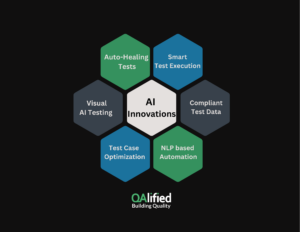
1. Auto-Healing Tests for Agile Environments
In agile development, changes to workflows and UI screens are constant as your developers add new features, fix bugs and enhance existing features. The continuous changes in UI elements and workflows create problems with existing test scripts, which fail during execution.
AI-powered auto-healing features of automation tools identify modifications in user interfaces and automatically update the UI locators and attributes. The result? The time spent repairing defective tests decreases while the team devotes more time to essential testing tasks. Fast-changing applications gain improved stability through this capability, which minimizes test automation maintenance effort and cost.
2. The Smart Test Execution Process That Prioritizes Testing
When your current code changes only affect 40 tests, 500 tests become unnecessary. Artificial intelligence capabilities examine commits, dependencies, and historical defect patterns to determine which tests should run and their proper execution order.
The approach selects tests through risk-based and change-impact assessments to ensure the most significant areas receive attention first. The method utilizes dynamic resource management alongside parallel testing to produce quick feedback while maintaining a concentrated test cycle.
3. Fast, Compliant Test Data Generation
The quality and speed of QA tests depend entirely on the availability of appropriate test data. AI tools generate synthetic test data that resembles real production data while ensuring regulatory compliance under GDPR, HIPAA and LGPD standards.
These tools produce data structures that match existing data models while meeting regulatory standards and providing coverage to test edge cases. Generating synthetic test data takes only minutes instead of days. Removing manual test provisioning bottlenecks and sensitive data protection risks makes test cycles faster and safer.
4. Natural Language Test Automation
The practice of creating automated test scripts traditionally required programming and test automation skills. However, it should be possible for business users and domain experts to participate in test case creation.
Non-technical users can now create, execute, and verify test cases through natural language with the help of AI bots. These bots integrated into Slack and Microsoft Teams enable non-technical testers to perform tests efficiently.
Effective collaboration between engineering and business teams will speed up your test cycles and produce smarter results. Team alignment enables testing to focus on essential user and stakeholder priorities, resulting in more relevant test cases, faster issue resolution, and higher product quality.
5. Test Case Optimization with NLP
Test regression suites frequently experience uncontrolled growth. Many teams waste time and cloud resources by running outdated, duplicate, and irrelevant test cases during their test cycles.
Through Natural Language Processing (NLP), AI can perform an analysis of test scripts and application features and change logs to achieve the following:
- Identify redundant test cases,
- Merge similar tests,
- Map coverage to business workflows.
This quality-preserving method makes the entire regression cycle more efficient while test volume decreases.
6. Visual AI Testing for Seamless UI Validation
Testing the User Interface across different browsers, devices, and screen resolutions creates a significant problem for testing teams. Manual-based testing approaches fail to identify minor interface problems, such as misplaced buttons, broken layouts, and style changes that users detect immediately. Also, the effort required to compare multiple devices, screens, browsers, and visual resolutions is very high.
Visual AI helps validate UI elements and switch between mobile, tablet, and desktop views without disorienting the design. With AI’s help, teams can ensure that every update protects the desired visual experience on all screen sizes, resolutions, and browsers.
What Business Value Does AI Bring to the Test Cycle?
Your test cycle receives AI integration to become a strategic growth driver instead of remaining a bottleneck. Accelerating releases produces rapid feedback loops, enabling faster innovation and greater market responsiveness. The lack of control when speeding up testing often leads to chaos. Implementing AI capabilities creates a sustainable velocity that brings assurance instead of causing anxiety.
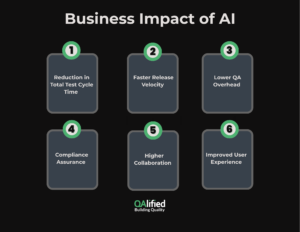
AI implementation delivers six primary outcomes to your software testing lifecycle:
1. Accelerating Delivery Without Compromising Coverage
The testing process under traditional methods involves repeated handoffs, waiting for environment setup, running extensive regression tests and maintaining large test packs. Implementing AI capabilities reduces test cycle duration through three key advantages:
- Automatically repairs broken test scripts whenever the user interface changes.
- Help prioritize tests with the highest probability of finding defects early in the test cycle.
- Automated the process of provisioning test environments and test data, avoiding human intervention and potential delays.
The test execution activities, which used to take days, now require only a few hours to complete. The operational efficiency achieved through the use of AI capabilities creates a competitive advantage.
To turn this efficiency into a repeatable operating model, organizations need structured planning, execution and reporting across every testing stage. Managed Testing Services can help teams scale AI-enabled QA practices, coordinate specialized resources and maintain continuous testing processes without increasing internal workload.
2. Faster Release Velocity Without Sacrificing Quality
Speed becomes useless when it results in buggy product releases. With AI:
- Testing aligns with every code commit in real-time, and the testers can now detect visual and functional regressions at their initial stages.
- The risk-based execution model ensures that essential paths receive complete coverage.
- Achieve faster delivery while maintaining full assurance about the security and stability of essential user paths that provide a memorable user experience.
3. Lower QA Overhead by Reducing Test Script Maintenance
Maintenance expenses are the most concealed yet costly aspect of automated testing. Test scripts experience frequent breakdowns in fast-developing products. AI capabilities decrease the testing burden through three significant features:
- Automatically updates locators with flow changes when the user interface undergoes modifications.
- Boosts confidence in test results by minimizing false positives and missed defects.
- Helps testers focus on exploratory testing and other key activities instead of dealing with defective scripts.
4. Compliance Assurance with Better Test Data
Organizations in finance and healthcare, along with government agencies, must adhere to strict compliance standards. AI provides:
- Accelerates test data generation while making information anonymous for regulatory purposes.
- Provide coverage for extreme and edge test cases that cannot be assessed using real data, improving application quality.
- The test cycle is compliant by design, meeting GDPR, LGPD, and HIPAA standards.
5. Higher Collaboration Between Engineering, QA, and Business Teams
AI’s underappreciated advantage in QA is its ability to facilitate team teamwork. Users without technical knowledge can create and run tests through natural language and chatbots integrated into Slack or Teams platforms. By leveraging AI capabilities:
- Product managers, alongside business analysts, can validate features by supporting faster decisions, tighter alignment, and better product outcomes.
- Provide immediate feedback that allows developers to evaluate their code quality, resulting in a lower cost of quality.
- The role of QA teams shifts from quality inspectors to quality supporters. Eliminating organizational barriers enables all teams to participate in quality discussions.
6. Improving End User Experience and Application Quality
The final user does not care about the quality of your test scripts or process. AI helps you deliver quality where it matters. Usage of AI capabilities will help to:
- Deliver consistent user experience across all devices, including phones, tablets, and desktops, which helps build customer trust.
- Maintain confidence on release day because testing stays synchronized with development, thus avoiding rush and reactivity.
- The combination of quick test cycles enables your team to provide quality feedback rapidly while reducing the cost of rework.
What Will the Test Cycle Look Like in the Future?
The purpose of AI technology is not to eliminate testing professionals from their roles; it’s to elevate them. Human insight regarding exploratory testing, ethical judgment, and understanding user intent is irreplaceable. But AI shines in the repetitive, time-consuming parts of the test cycle. Here’s what the future of the test cycle looks like:
- Continuous testing that adapts to every change
- Self-learning test suites that improve over time
- Human-AI collaboration that balances speed with strategy
- Auto-generate regression tests from user journeys and behavior insights.
It is not just about testing faster. It is about testing smarter and making quality a competitive advantage.
Conclusion: From Bottleneck to Catalyst
The test cycle is no longer a back-office function. It’s a business enabler.
By embracing AI, organizations can transform their testing teams into strategic assets. The first step toward an AI-optimized test cycle starts with any initiative that includes auto-healing scripts, smarter test execution, or visual testing. You don’t have to replace everything at once, but you need to start before your competitors leave you behind.
The team at QAlified assists organizations in transitioning from conventional testing practices to AI-enhanced quality engineering practices. Production issues should not be the trigger for identifying gaps. We help organizations to develop an AI-enabled test strategy that transforms QA into a business enabler. Ready to transform your testing process with AI?
SHARE:

