


Organizations are working to speed up and improve AI-powered software delivery through better testing approaches that are more efficient. Cloud-native applications operate through dynamic scaling, while mobile-first platforms have become standard practice.
Multiple teams encounter recurring quality issues because their test suites fail to deliver reliability. They also experience late-stage regressions as costs rise and users become dissatisfied.

The test pyramid concept that emerged decades ago is more important than ever in today’s software development landscape. It continues to exist despite common misconceptions that AI and DevOps have eliminated it. It’s been reinforced. This blog provides essential information about the software testing pyramid for CXOs, product Leaders, founders, and QA Heads who want to build reliable applications quickly.
What Is a Test Pyramid?
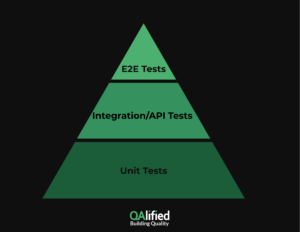
The test automation strategy of the test pyramid divides tests into three logical layers.
- Unit Tests (Base): Validate individual functions, classes, or components. These are fast, granular, and run in isolation.
- Integration/API Tests (Middle): Ensure different modules, APIs, or services work together correctly.
- End-to-End (UI) Tests (Top): Simulate real-world user journeys to verify the application from a user perspective.
The foundation of a skyscraper should be its widest and strongest section. You don’t build from the top down. A solid testing approach begins with the foundation. The pyramid application enables you to develop quality from the beginning while providing quick feedback throughout each stage.
Why does Test Pyramid Still Matter in 2025?
The software and product engineering environment of 2025 operates through fast-paced, complex systems that continuously transform. AI tools produce tests while cloud-native applications scale automatically, and serverless architectures transform when the load increases. A structured method becomes essential for managing this disorder.
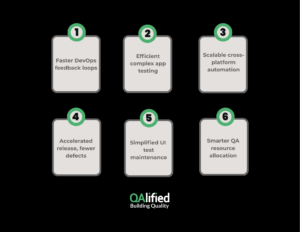
The test pyramid brings predictability:
1. Faster DevOps feedback loops
The test pyramid enables developers to run unit and integration tests quickly during the early stages of code commitment to detect regressions. The end-to-end validation process receives 90% of issues before the change reaches this stage. The quick feedback loop enables teams to make confident releases while maintaining continuous integration.
2. Efficient complex app testing
The pyramid enables organizations to maintain control over automation when their applications transform into microservices or serverless functions, or AI-powered workflows. The pyramid structure maintains simplicity and focuses on each level, which prevents test coverage from becoming excessive through duplicated tests or delayed processes.
3. Scalable cross-platform automation
The pyramid testing approach works for all applications, including React frontends and mobile apps built in Kotlin and ML workflows triggered by APIs. The framework helps teams determine which automation investments will sustain pipeline efficiency without overwhelming the application.
4. Accelerated release, fewer defects
The DORA State of DevOps Report of 2024 shows that 19% of organizations achieve one-day change delivery and deploy multiple times daily while maintaining a 5% change failure rate. Through a pyramid-based automation structure, organizations achieve better stability and environmental consistency. The combination of fewer hotfixes, reduced rework, and shorter go-to-market timelines improves user trust and retention
5. Simplified UI test maintenance
Organizations achieve better stability and environmental consistency through a pyramid-based automation structure. The result is faster debugging, more reliable test runs, and greater confidence in releases even as the application evolves.
6. Smarter QA resource allocation
The pyramid recommends performing only essential flows through UI automation because UI tests remain the most fragile and difficult to maintain. This approach reduces debugging time and eliminates false positives resulting in lower costs during UI evolution.
How the Test Pyramid Complements AI-First Testing
The Test Pyramid functions as a complementary framework to AI-first testing
AI testing tools are now mainstream. They:
- Generate test cases from requirements.
- Suggest missing validations.
- Auto-heal brittle locators.
- Run autonomous exploratory sessions.
But here’s the catch: AI still needs structure.
AI tools will generate thousands of unnecessary tests if left without proper control. The pyramid ensures:
- The generated unit tests maintain their focus on modularity.
- The integration flows maintain alignment with business requirements.
- UI tests stay minimal and purposeful.
As per the 2025 Continuous Testing Report from Perforce, more than 30% of the organizations are facing challenges with test instability. The pyramid serves as a boundary to determine where AI-generated tests should exist, which helps maintain test suites that are efficient, relevant, and scalable.
Applying the Test Pyramid to Modern App Architectures
Cloud-Native and Microservices
The modern platform consists of multiple independent services that operate independently. The pyramid testing approach finds its best application in this context:
- The testing of service contracts between services prevents integration failures.
- Test containers and other container-based test runners provide independent testing environments.
- Service virtualization enables the removal of third-party dependency constraints.
The layered automation system enables teams to identify API-level issues before they affect users.
Mobile and Web Apps
The process of testing across multiple platforms requires significant resources. The testing approach helps organizations achieve better efficiency through its implementation.
- Unit tests verify the business logic that exists within mobile/web SDKs.
- Emulators/simulators support mid-tier integration tests.
- Real-device labs execute only a limited number of essential UI flows.
The outcome results in reduced redundancy, faster validation, and improved device coverage.
AI-Driven Apps
Testing AI represents an entirely new testing domain. The validation process requires verification of both code and model components.
- The testing process includes unit tests that check preprocessing logic, business rules, and thresholds.
- Integration tests verify that model inputs produce consistent outputs.
- The UI testing process verifies that AI features, including OCR and recommendation engines, operate correctly.
AI reliability depends on structured testing. The pyramid provides that structure.
Test Pyramid vs Trophy vs Diamond: Which One Fits Your Strategy?
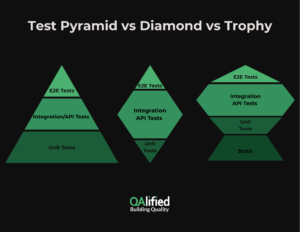
The test pyramid, trophy, and diamond represent three approaches to structuring automated test layers. The pyramid structure starts with unit tests as its base, followed by fewer integration and UI tests to achieve speed and low maintenance. The trophy model emphasizes integration tests as the best method to check complex service interactions.
The diamond model provides a balanced approach by giving equal importance to unit and integration testing while keeping UI tests to a minimum. The three models serve different project requirements based on architecture type, risk tolerance and delivery speed.
Leadership Takeaways: What CXOs and QA Heads Should Do
Leaders aiming to scale software quality must:
• Promote shift-left testing
- Empower developers to write and maintain unit and API tests in the development workflow.
- Integrate test execution into code commit pipelines for early feedback.
- Reduce reliance on late-stage UI testing by catching issues earlier.
• Make AI work with the pyramid
- Select AI tools that assist in generating test data, identifying coverage gaps, and auto-healing flaky tests.
- Ensure AI-generated tests align with the intended layer (unit, API, UI) and don’t create redundancy.
- Use ML insights to improve test suite effectiveness, not just expand it.
• Enforce measurable metrics
- Track key KPIs like test coverage, pass/fail rates, and execution time.
- Use dashboards to monitor regression stability and detect trends in flaky tests.
- Set benchmarks for acceptable defect escape rates post-release.
• Invest in test infrastructure
- Adopt cloud-based device/browser labs to simulate real-world conditions at scale.
- Leverage containers and virtualization to enable parallel and isolated test runs.
- Automate test environment provisioning to reduce setup delays.
• Champion cross-functional quality
- Include QA in design and grooming sessions to ensure testability from the start.
- Encourage developers, testers, and product owners to review test cases and results jointly.
- Shift from siloed testing teams to integrated quality ownership across roles.
A strong pyramid strategy translates to:
- Predictable release cycles
- Happier users with fewer issues
- Lower production risks and rework costs
Common Mistakes to Avoid while Implementing the Test Pyramid
1. UI-heavy test suites
- Excessive end-to-end UI tests create slow feedback loops and unstable test execution.
- The maintenance costs of UI tests remain high, but they easily break when the UI undergoes minor modifications.
- The execution of CI/CD cycles becomes delayed while developer confidence in test results decreases.
2. Ignoring API testing
- Most bugs emerge from business logic and service layer operations instead of user interface elements.
- The absence of API testing creates unverified integration points, which makes debugging more challenging.
- API testing delivers faster execution times and better reliability than UI testing methods.
3. Blind faith in AI
- Without proper guidance, generating test cases through AI tools produces excessive or useless tests.
- Tools’ automatic test healing process can incorrectly fix issues that hide actual problems.
- AI systems lack human supervision, which causes them to perpetuate inefficiencies instead of resolving them.
4. Testing in silos
- The practice of assigning testing duties to QA alone creates delivery delays and weakens team-wide responsibility.
- The absence of developer and product manager involvement leads to quality impact oversight.
- Team collaboration during testing produces improved test coverage and faster issue resolution.
Early detection of these problems leads to:
- Build a stable, maintainable automation framework
- Improve test feedback cycles
- Align quality efforts across teams
Frequently Asked Questions About the Test Pyramid
1. What is the testing pyramid?
The test pyramid is a best-practice framework for test automation that achieves optimal cost and speed performance through a bottom-heavy distribution of unit integration and UI testing layers.
2. What is Mike Cohn’s test model?
Mike Cohn developed the test pyramid to promote fast, low-level automated tests, which decrease reliance on slower UI tests. Thus, the pyramid enables faster feedback and more maintainable automation suites for Agile environments.
3. What types of tests should be the most according to the test pyramid?
The test pyramid indicates which types of tests should appear most frequently.
Unit tests need to be the most prevalent ones. The testing process runs quickly and separates logical code segments, enabling developers to detect problems early in development.
4. What is a test pyramid in Agile?
The test pyramid within Agile supports continuous delivery by emphasizing automated unit and integration tests rather than UI tests. This approach eliminates development bottlenecks while enabling fast, repetitive development cycles.
5. What is the difference between the test pyramid and test trophy in software testing?
The test pyramid differs from the test trophy in software testing through its unit testing versus integration testing approach. The test trophy places more importance on integration tests than unit tests because excessive types might fail to detect actual application behaviors.
6. Which approach is better: test pyramid vs test diamond for scalable automation?
The best scalable automation approach should be identified between the test pyramid and the test diamond. The test diamond includes additional integration tests compared to the pyramid. The pyramid functions effectively with strong CI/CD pipelines and modular architectural designs for scalable automation.
7. What are the 5 levels of the pyramid of testing?
The test pyramid has been expanded into five testing layers, which include unit tests, followed by component tests, integration tests, system tests, and acceptance tests. The added level of validation progresses step by step throughout each application stage.
Conclusion:
The test pyramid will remain an essential method for delivering high-quality software throughout 2025. Through layered testing from unit to UI, teams can achieve faster development, lower costs, and improved application resilience, even when dealing with AI-driven complexity and modern architectures.
The choice between AI and structure does not exist because organizations should use both approaches to create intelligent, scalable testing systems. The pyramid-aligned approach has become essential for CXOs, product Leaders, and QA Heads because it serves as the base for sustainable innovation.
Our team at Qalified partners with QA leaders, engineering teams, and product stakeholders to implement scalable, AI-augmented test automation strategies grounded in the test pyramid. We focus on reducing maintenance overhead, accelerating delivery cycles, and ensuring your quality goals align with modern development practices. Let’s talk about how we can tailor a solution for your team.
👉 Start Your Automation Journey – Book a Call
SHARE:

