


Testing delays, flaky automation, and outdated cycles are no longer just technical issues — they’re business risks. Legacy STLC models can't keep up with the speed of modern development.
A smarter STLC unlocks faster releases, higher stability, and better user trust. Learn how AI, automation, and modular practices can transform your testing pipeline from reactive to strategic.

Introduction: Why Modern STLC Needs a Makeover
The Software Testing Life Cycle (STLC) describes the organized process that QA teams use to verify software quality and stability. The traditional SW testing life cycle faces numerous challenges. Agile sprint cycles are shrinking. AI controls every stage of development, from design through production. The CI/CD pipelines need to operate continuously throughout the day. The current environment requires organizations to abandon traditional testing approaches because they create more problems than solutions.
The combination of flaky automation, bloated regression suites, and delayed feedback loops creates problems that extend beyond project timelines, increasing costs and reducing product stability. Optimizing the STLC in software testing has evolved from a desirable engineering practice to a mandatory strategic business choice, affecting release speed, user satisfaction, and corporate image.
Modern teams should view testing as an adaptive and intelligent component of their delivery pipeline, rather than treating it as a bottleneck. The approach must evolve from “test more” to “test smarter.” Let’s look at how.
The Cost of Delays in Testing
The Tricentis State of Enterprise Application Testing Report indicates that leading organizations average test cycle durations of about 23 days. The prolonged testing duration demonstrates the necessity for improved testing practices that support quick software development cycles.
The Consortium for Information & Software Quality (CISQ) reports that the finding and fixing of software defects cost around $607 billion for U.S. businesses in 2022.
The actual source of pain for founders, app owners and QA leaders stems from the following:
- Escalating test infrastructure and tool costs
- Increased production outages
- Late-stage defect discovery that breaks core workflows
Each delay disrupts time-to-market while simultaneously damaging stakeholder trust. The fast-moving sectors of fintech and health tech experience significant risk exposure when downtime or compliance issues exceed a few hours because they result in millions of dollars in potential losses.
What Modern STLC in Software Testing Should Look Like
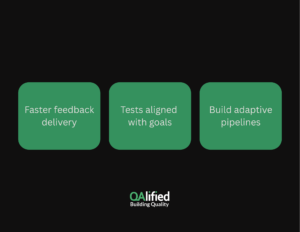
A modernized STLC should be lean, modular, and intelligence driven. The goal is not to replace QA teams with automation or AI, but to empower them to:
- Faster feedback delivery without sacrificing depth
- Tests should be continuously aligned with product goals and user journeys
- Build adaptive pipelines that evolve with product velocity
The main objective of a modernized STLC is not to test everything but to focus on testing the right things at the right time and using the right approach. This approach, which is lean, modular, and intelligence-driven, ensures that the testing efforts are always strategic and impactful.
10 Strategic Ways to Improve STLC and Accelerate Releases
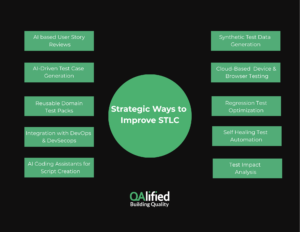
1.AI-Based User Story Review
The combination of NLP and AI enables teams to automatically assess user stories for their completeness, clarity, and testability. Early detection of missing validations edge cases and potential risks becomes possible through this method, preventing them from affecting downstream test cases. The process enables QA teams to work with development teams and product management to improve acceptance criteria.
The unclear or evolving requirements process leads teams to decrease their rework and delays. AI-based story review tools provide real-time improvement suggestions during backlog grooming sessions through direct integration. The outcome produces enhanced planning, together with precise requirements and superior test coverage.
2.AI-Driven Test Case Generation
AI-powered tools analyze product workflows, logs, or user stories to auto-generate test cases. This dramatically reduces the time spent writing and maintaining test scripts. These tools also prioritize tests based on impact and usage frequency, helping teams focus on high-risk areas first. For frequently changing applications like mobile banking or e-commerce, this ensures test relevance remains high.
Machine learning models learn from past defects, user flows, and release history to predict which tests matter most. This leads to more comprehensive regression testing, better coverage, and faster onboarding of new features without the manual scripting backlog that typically slows teams down.
3. Synthetic Test Data Generation
Synthetic data generators enable QA teams to generate large amounts of realistic data that follow regulations for testing purposes. The process eliminates two significant problems: the provision of sanitized production data and privacy risks. The healthcare and finance sectors, where sensitive production data cannot be used for testing, can now perform testing through synthetic data without violating data regulations.
The approach enables users to generate data based on specific scenarios while producing data to test edge cases. Combining automation with synthetic data allows the team to perform continuous tests to validate application quality. The implementation of synthetic data leads to decreased test failures, accelerated environment setup, and improved simulation of everyday life scenarios, especially during integration and performance testing.
4.Reusable Domain-Specific Test Packs
Reusable test packs contain pre-built scripts and components that implement standard business flows, including login, cart checkout, payment, and KYC. These packs’ central version control and maintenance enable their use across multiple projects. QA teams can avoid wheel reinvention by using these packs in new test suites, saving time and maintaining consistency.
Many code-less test automation platforms now provide reusable test automation packs for packaged applications such as SAP, CRM Dynamics, Salesforce, etc. Using reusable packs speeds up testing in agile environments by decreasing test design work while expanding coverage and reducing test case errors. Teams can dedicate their resources to testing new business logic instead of spending time on maintaining baseline functionality.
5.CI/CD Integration with DevOps & DevSecOps
The integration of testing within CI/CD pipelines enables continuous validation. The code commits process starts with a sequence of tests, including functional, performance, and security checks, to provide immediate feedback. The proactive method decreases the work needed to fix defects and shortens the time required to resolve them. Security scans integrated at an early stage help organizations maintain compliance with regulatory standards.
DevSecOps integrates security into the same automation layer, enabling organizations to release products faster without compromising quality. The DevOps tools Jenkins, GitLab, and Azure DevOps provide modular test orchestration capabilities that match the requirements of modern agile and micro-services workflows. Teams following this approach experience shorter feedback cycles, faster build recovery times, and better developer-test collaboration.
6. AI Coding Assistants for Test Script Creation
AI-based code assistants GitHub Copilot and Amazon CodeWhisperer aid QA engineers in writing test scripts through real-time suggestions of code block syntax corrections and automation logic. The tools speed up the development of scripts for Selenium, Cypress, and Playwright frameworks.
The assistants help maintain test quality by finding flaky patterns and deprecated functions. AI assistants help junior engineers and teams adopt new frameworks to learn faster. The outcome includes faster development of automation assets, reduced scripting errors, and standardized test design standards throughout the team.
7.Self-Healing Automation
Self-healing test frameworks employ AI technology to find UI elements and API changes, which triggers automatic script modifications. The frameworks prevent test cases from becoming brittle by detecting small UI layout changes, element ID modifications, and endpoint parameter updates. The frameworks use DOM tree analysis, visual hierarchy inspection, and API contract evaluation to preserve test stability
Self-healing proves essential for dynamic applications, including single page applications and mobile apps, because it decreases test maintenance requirements while maintaining pipeline success rates. The capability ensures test coverage remains uninterrupted during releases, resulting in faster release cycles and reduced firefighting work for QA teams.
8. Cloud-Based Parallel Device & Browser Testing
Cloud-based testing platforms enable simultaneous test execution across various device and browser combinations. The approach delivers real-world compatibility while speeding up the testing process. Workload distribution engines with intelligence capabilities execute tests simultaneously on the most critical environments decided by usage data or customer traffic.
The testing process becomes faster when apps serve users from different environments because this approach helps identify device and browser specific problems.
Teams can duplicate testing conditions across Android, iOS, Chrome, Firefox, and other platforms without setting up device and browser lab facilities. The integration with CI tools allows teams to perform automated cross-platform validation within minutes instead of hours. The testing cycle duration decreases substantially while end-user experience consistency improves.
9.Regression Test Optimization
The growth of test suites leads to the accumulation of unnecessary test cases with little value. Regression test optimization uses coverage data, change history, and failure trends to improve the suite. AI-based tools use natural language processing to identify redundant and similar test cases, which helps remove obsolete test cases and merge identical test cases.
The optimization process decreases test execution time while enhancing reliability through focused validation of essential tests. The test case optimization process maintains a lean test suite that remains focused and maintainable. Optimization enables exploratory testing and new automation initiatives while keeping technical debt manageable.
10.Test Impact Analysis
Test impact analysis determines which test cases should run based on recent code modifications. This approach depends on code-to-test traceability and historical defect patterns to determine essential areas. It reduces execution time by running only relevant tests, leading to improved test cycle efficiency.
The approach works best for big codebases that consist of multiple independent components. Combining risk-based testing with impact analysis enables teams to maintain their speed while ensuring complete coverage. Automating this process within CI pipelines enables fast commit validation without delaying the release process.
FAQ’S on Software Testing Life Cycle
1.What are the 7 phases of STLC?
Software Testing Life Cycle (STLC) contains seven phases: 1) Requirement Analysis, 2) Test Planning, 3) Test Case Design, 4) Test Environment Setup, 5) Test Execution, 6) Defect Reporting, and 7) Test Closure .The phases progress sequentially to achieve systematic validation and delivery of high-quality, defect-free software.
2. What is an STLC?
STLC represents a structured method containing predetermined testing stages that guarantee software quality. The process begins with requirement analysis, followed by test planning, design execution, and defect tracking before it concludes with closure. The main objectives of STLC include defect identification at early stages and risk reduction to meet business expectations and user needs.
3. What is STLC and its types?
STLC represents the collection of testing activities that aim to guarantee software quality. The process supports multiple testing approaches, including static testing, functional testing, regression testing, performance testing, and user acceptance testing. Implementing STLC depends on Agile, Waterfall, or DevOps development methodologies since each requires distinct test planning, automation, and feedback loop approaches.
4. What is SDLC vs STLC?
The SDLC (Software Development Life Cycle) includes all stages of software development, from requirements definition to deployment and post-deployment maintenance. STLC (Software Testing Life Cycle) is a specific testing framework that verifies and validates software systems. The software development life cycle (SDLC) takes care of what and how to build software, while STLC focuses on verifying correct software operation before release.
5. What is the life cycle of software testing?
The software testing life cycle follows a sequence of phases to check and validate software quality standards. The testing process begins with requirement analysis and continues through planning test case development and environment preparation before moving to execution, defect reporting, and finally closure. The software testing process checks for correct function, reliability, user-friendliness, and performance by identifying and resolving defects as soon as possible.
6. How does AI help to cut down STLC efforts?
The application of artificial intelligence cuts down STLC efforts by creating automated tests, identifying faults early, and selecting tests based on intelligent methods. AI tools help test script maintenance through self-healing functions, analyse logs for fast debugging, and use historical data to forecast high-risk areas.
Combining automated testing with CI/CD pipelines, AI-driven test prioritizations, and automated script generation results in faster test cycles and higher accuracy within evolving development environments.
7. How can I speed up my software testing life cycle?
You can speed up your testing lifecycle through AI-based script generation, business impact-based test case prioritizations, and automated testing integration into CI/CD pipelines. Synthetic data helps solve data-related challenges, enabling continuous production feedback. These practices cut down delays while improving accuracy, allowing QA teams to handle modern development environments quickly.
Conclusion
Modernizing the Software Testing Life Cycle (STLC) has become mandatory because it enables organizations to achieve faster, higher-quality releases. The current agile AI-driven and high-stakes environments make traditional testing methods insufficient.
Teams can decrease test cycle duration and reduce cost while improving product stability by implementing AI-based story reviews, synthetic data generation, self-healing automation, and CI/CD with DevSecOps integration. A lean modular STLC enables QA teams to transition from bug detection to proactive risk prevention and business alignment.
The focus should shift from testing more to testing with innovative methods prioritising essential user and business needs. Speed and resilience depend on intelligent automation, adaptive pipelines, and impact-based testing. QAlified helps organisations in redesigning their STLC from the beginning when they need to expand quality while maintaining release speed.
Talk to our team and discover how to establish an intelligent testing process that delivers value quickly while maintaining quality standards.
SHARE:

