


Large Language Models are rapidly becoming part of modern software systems. From customer support assistants to enterprise AI tools, these models are transforming how applications interact with users and generate information. As organizations adopt generative AI at scale, ensuring the quality of these systems becomes a critical challenge.
Traditional QA practices were designed for deterministic systems where the same input always produces the same output. LLM-based applications behave differently. Their responses can vary, making quality validation more complex and requiring new testing strategies.

The software landscape is more dynamic than ever before. Large Language Models are no longer a curiosity used for research and experimentation, but can be found in customer support chatbots, search engines, and even coding assistants. As of 2025, 67% of organizations worldwide are using LLMs to support their operations with generative AI.
As these technologies continue to be adopted and play a larger role in our daily business processes, it’s essential that our approach to quality also changes with them. For a QA team, this means that it’s time to think differently about testing.
The current state of testing and validation was designed for a world in which a given piece of input would always produce a predictable outcome. This is not the case with LLMs, where a given prompt may produce different results each time it’s entered. This creates a problem that requires new solutions, which is why LLM testing is becoming an essential skill for modern-day QA teams.
What Is LLM Testing?
LLM testing is the process of validating the responses generated by the LLM with respect to accuracy, relevance, fairness, and so on, depending on the actual use case. LLMs do not produce identical outputs for identical prompts. This means that the test is not aimed at finding the “right” or “wrong” answer; rather, it is aimed at finding the quality of the response.
The test is usually aimed at finding the following:
- Hallucinations or made-up facts
- Accuracy
- Fairness and absence of toxic content
- Validation with respect to business requirements
The role of QA changes from validating the responses generated by the system to validating the responses with respect to the metrics and standards established.
Testing LLMs involves two essential steps: designing representative scenarios and evaluating outputs at scale.
QA teams use:
- Prompt libraries simulating real user inputs.
- Evaluation functions to score generated responses.
- Automated feedback loops to detect regressions.
A simple example: you evaluate a customer support LLM by feeding it 100 actual tickets and scoring its answers using criteria like factual correctness and tone. If 90% of responses meet thresholds, the test passes.
LLM evaluation tools such as DeepEval and Langfuse allow teams to integrate automated checks into CI/CD pipelines, ensuring that model updates are validated before release. Frameworks focused on AI response quality validation, such as Artificial QA, provide structured approaches to test hallucinations, reliability, and safety in generative AI systems.
If quality is essential, the next step is understanding how we measure it. This is where the distinction between testing and evaluation becomes important.
LLM Testing vs LLM Evaluation: Key Differences and Complementary Roles
| Aspect | LLM Evaluation | LLM Testing |
| Purpose | Measure the overall capability of a model | Verify that the model works correctly in a specific application |
| Focus | General performance and reasoning ability | Behavior in real-world scenarios and business use cases |
| Typical Method | Benchmarks and standardized datasets | Test cases, prompts, and validation scenarios |
| Metrics | Numerical scores (accuracy, benchmark results) | Pass/fail results based on expected behavior |
| Example | A model scores 86% on MMLU | Testing whether a chatbot avoids giving financial advice |
| When It Is Used | Model selection and comparison | Pre-deployment and continuous validation |
| Key Question | “How good is this model overall?” | “Is this model safe and reliable for our use case?” |
It is easy to confuse LLM testing and LLM evaluation because both involve measuring model quality. They have different applications, and recognizing this distinction can prevent coverage gaps. LLM evaluation involves overall ability. It measures how well a model performs on standardized datasets or benchmarks.
The result is typically a numerical score that represents accuracy, reasoning capacity, or language understanding. For instance, a model may receive a score of 86% on a benchmark such as MMLU. This is useful for comparing models and determining which one seems better at general tasks. Evaluation answers the question: “How good is this model overall?”
LLM testing is more applied and scenario-related. It involves how the model will perform in specific scenarios related to your product. The results typically pass or fail depending on expectations. For instance, you can test whether your customer service bot will consistently refrain from providing financial advice or whether it properly cites internal documentation. Testing answers the question: “Is this model safe and reliable for our use case?”
In real-world projects, both are required. Evaluation will help you choose a competent model in the initial stages. Testing will ensure that the chosen model works well in your application. One checks potential. The other checks readiness. Both ensure a balanced and responsible approach to developing LLM-based systems together.
Once the difference is clear, the next question becomes practical: how do you test LLMs effectively in real-world systems?
Types of LLM Testing Strategies
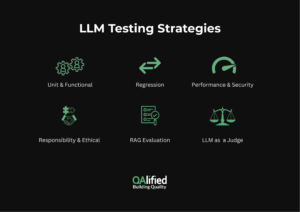
A good QA strategy is a combination of several testing types, as there is no single testing type that can encompass all the risks involved in using LLMs. Each testing level targets a different issue, ranging from simple correctness to safety and overall long-term correctness. Here’s how effective teams organize their testing plan.
1. Unit and Functional Testing
Begin small and specific. Unit testing is performed to see how the model behaves when given a single input. For instance, you may test the model to see if it includes the proper company name in the summary and does not include any unsupported statements. Functional testing takes it a step further and tests the model for a larger task, such as customer inquiries.
2. Regression Testing
Regression testing tracks performance against a fixed baseline over time. This is important because models can alter their performance after fine-tuning, retraining, or updates to the prompt. Without a baseline, small decreases in quality can be missed. Comparing new results to past results can help determine when performance has decreased. Establishing thresholds, like ensuring accuracy is above 85 percent, can help identify issues early and keep performance stable.
3. Responsibility and Ethical Testing
For a production-level system, testing for harmful behavior is necessary. This includes testing for toxicity, gender or racial bias, stereotyping, and dangerous responses. Models trained on large internet datasets may reflect existing societal biases. Using a structured test with a dataset such as HELM or Real Toxicity Prompts can help model real-world risk scenarios.
4. Performance and Security Testing
LLMs are resource-intensive and can be misused. Performance testing measures response time, memory usage, and cost under real-world load. Security testing involves analyzing the system for attempts at prompt injections, jailbreak plans, and leaks. Attack simulations assist in identifying vulnerabilities before deployment.
5. RAG Evaluation
In Retrieval-Augmented Generation systems, testing is required for both the retrieval and generation processes. The system is checked for retrieving relevant and trustworthy information, and the answer remains rooted in that information. Faithfulness and citation accuracy are some of the metrics used for this purpose.
6. LLM-as-a-Judge
In open-ended applications such as content writing or tutoring, rule-based testing may not be sufficient. In such applications, a different model can be used to judge the output based on certain criteria such as clarity, helpfulness, tone, and creativity.
Why Is LLM Testing Important for QA and Enterprise AI?
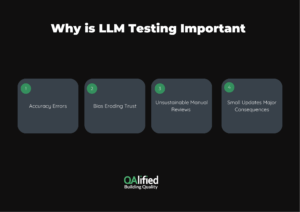
The challenge for QA teams is increasing rapidly. According to McKinsey (2025), over 40% of enterprise leaders intend to integrate LLMs into their core business processes. These technologies are no longer niche projects. They are influencing customer conversations, business decisions, and product development.
This is what it looks like in reality:
- Accuracy errors pose real risks: Even advanced models can generate incorrect information 3–10% of the time. In regulated sectors like finance, healthcare, or law, even small errors can lead to serious consequences.
- Bias can undermine trust: If a model reflects stereotypes or prejudice, users will notice. In areas like hiring or lending, biased outputs can create compliance issues and damage reputation.
- Manual review does not scale: While QA teams can review dozens of responses manually, this becomes impossible when systems handle thousands of interactions per day.
- Small updates can have big impacts: Minor prompt changes can unexpectedly affect tone, accuracy, or compliance, sometimes removing critical elements like required disclaimers.
If quality is essential, the next step is understanding how we measure it. This is where the distinction between testing and evaluation becomes important.
Final Thoughts on LLM Testing
AI is no longer experimental. It is now part of your core technology stack, and it must be validated like any other critical system.
LLM testing gives QA teams a structured way to manage this complexity. By applying regression testing, RAG evaluation, and LLM-as-a-judge techniques, organizations replace guesswork with measurable validation.
This is how mature teams manage AI today. When AI systems influence customer decisions, compliance outcomes, and operational workflows, quality becomes a business responsibility, not just a technical one.
If LLMs power your core systems, testing is not optional. Unvalidated AI introduces operational and reputational risk.
Connect with QAlified to design and implement a scalable LLM testing strategy that protects your brand, reduces risk, and ensures reliable AI performance at every release.
Looking for broader QA expertise? Learn more about our QA Consultancy Services, where our specialists help organizations strengthen their overall software quality strategy.
FAQ’s on LLM Testing:
1. How to test the LLM model?
Testing an LLM involves establishing what constitutes “good” performance for your application. This involves crafting realistic test prompts, assessing the output for accuracy and safety, and comparing the outcome to specific criteria. Automated testing is preferred, but edge cases are best assessed manually to identify nuanced problems.
- What are the tools used to test LLM?
Typical tools for testing LLMs include DeepEval for automated testing, Langfuse for monitoring and tracing, and RAGAs for testing retrieval systems. Teams also develop custom scripts to assess outputs. The choice of tool depends on whether accuracy, safety, performance, or reliability is being tested.
3. How to test LLM results?
To test the results of an LLM, the output can be compared to specific standards of quality, such as accuracy, tone, and completeness. Scoring systems can be used to assess consistency over a series of test prompts. Testing for both typical and edge cases can help ensure the LLM is functioning as expected in practical applications.
4. How do I unit test an LLM application?
Unit testing of an LLM application involves testing the response of the model to a given prompt. The expectations can be set, for instance, to include essential information and to not provide dangerous suggestions. The test is to be run multiple times to ensure consistency and that the output complies with the set quality standards.
SHARE:

