


Payment systems are key to modern commerce. They enable online retail checkouts, in-app purchases, and recurring subscription billing. One declined payment can result in immediate revenue loss, customer attrition, and erosion of trust.
Payment testing addresses this challenge by examining every part of the payment transaction. It covers testing payment behavior in normal and edge-case scenarios across devices and payment methods.
This blog will discuss what payment testing is, its importance, and the various types of testing. We’ll explain how we do it at QAlified using a clear example, suggest tools, share best practices, and discuss challenges.
What is Payment Testing and why is it Necessary?
Payment testing verifies the accuracy, security, performance, and usability of a payment system in real and simulated environments. It addresses every part of the transaction lifecycle. This includes data entry, authorization, capture, settlement, refunds, reversals, and chargebacks.
Organizations rely on it to avoid:
- Loss of revenue due to missed, rejected, or duplicate payments.
- Damaged reputation due to misleading or unsuccessful checkout processes.
- Security attacks involve the exposure or theft of sensitive financial data.
- Regulatory breaches due to failure to follow such standards as PCI DSS or PSD2.
Payment systems have many layers, and they are quite complex. These layers connect in various ways, including:
- Web or mobile platform user interface elements.
- APIs
- Payment gateways or processors are used to process requests and responses.
- Card schemes like Visa, Mastercard,Amex and banking networks.
- Components of fraud detection, risk scoring, and compliance enforcement.
Without formal testing, even small bugs like incorrect currency rounding, wrong tax calculations, or API timeouts can lead to big problems. These issues may cause system-wide failures, lost transactions, and costly fixes.
What can be Tested and How?
Here are the five key payment tests needed for reliable, safe, and user-friendly transactions.
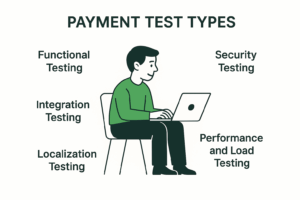
Functional Testing
Functional tests verify that fundamental payment processes work as expected. They include checks for amount accuracy, input verification, clear error messages, and confirmation page rendering. Identifies logical errors or user interface bugs prior to launch.
Integration Testing
Integration testing ensures your system communicates effectively with payment processors or gateways. It validates API endpoints with authorization, capture, refund, and void actions. Prevents failures caused by incompatible request formats or incorrect endpoint handling.
Security Testing
Security testing verifies encryption, scans for vulnerabilities, and conducts penetration tests to protect cardholder data and prevent fraud. It tests compliance with PCI DSS and other standards. This helps to make payment information safe to store and use secure transmission.
Performance and Load Testing
Tests peak transaction loads to check stability, response times, and system throughput. Identifies bottlenecks that could slow down or cause collapse during busy events.
Localization Testing
Checks payments in various currencies and languages. This adheres to local tax regulations and accommodates various payment methods. This approach prevents user confusion and minimizes transaction errors.
How We Do Payment Testing at QAlified
Here’s a closer look at the method we use to provide reliable, compliant, and high-performing payment solutions.
Test Data Setup and Environment
The process starts by creating sandbox environments. These environments mimic production infrastructure, including payment gateways, fraud detection modules, and settlement services.
Synthetic or masked production data fills these settings. It mimics various currencies, payment types, card states, and customer profiles. This happens without risking compliance.
Coverage testing happens on real mobile phones and cross-browser setups. We use platforms like BrowserStack for maximum accuracy.
Payment integration Mapping
Next, list all the gateways, processors, and network partners. Also, note the API endpoints for authorization, capture, refund, void, and dispute workflows.
We provide coverage for all transaction types, including P2P transfers, cross-border payments, BNPL, subscriptions, and multi-currency settlements.
These integration workflows include key regulatory steps. They cover KYC, OFAC screening, Dodd-Frank, and PSD2 strong customer authentication.
Automation and Test Design
Next, we design test suites for functional, integration, API testing, and end-to-end transaction flows. This applies to desktop and mobile devices.
Automation frameworks like Playwright and others handle routine tasks well. In contrast, exploratory manual testing uncovers unexpected issues and usability challenges.
Defects are logged in centralized systems like Azure DevOps or others. This makes them traceable and easy to fix.
Performance and Scalability Tests
This simulates expected and maximum transaction loads. Tools like JMeter or others help measure throughput, manage concurrency, and ensure stability.
Stress testing focuses on high-value, high-frequency transactions. This includes bulk supplier payments and recurring billing. It examines how these transactions perform under various network and latency conditions.
Bottlenecks appear at the API, database, and gateway levels. We take corrective actions before the release.
Security and Compliance Tests
Run vulnerability scans and penetration tests on:
- Payment APIs
- Encryption layers
- Authentication flows
Use tools like OWASP, ZAP, Burp Suite or others. Compliance checks follow PCI DSS, PSD2, GDPR, and local rules. Documentation is then prepared for audits.
Security measures such as tokenization, TLS 1.3 encryption, secure credential storage, and multi-factor authentication work well in live transactions.
Real Case: Testing Cross-Border Payments
A cross-border payments product had an SDK in a mobile app. It required thorough testing across various transaction types. The team conducted functional and integration testing on iOS, Web, and Android devices. For backend verification, we used PostgreSQL and Postman. Azure DevOps served as our defect tracker.
Regression suites included P2P, P2B, B2P, and B2B flows, along with regulatory processes such as KYC and OFAC screening. The 30-minute cancellation rule from Dodd-Frank was also addressed.
With hundreds of test cases, we achieved stability, caught defects early, and integrated smoothly with Visa, Mastercard, and global payment networks.
Recommended Tools to Run Payment Tests
Selecting the right tools is essential for ensuring thorough, efficient, and reliable payment testing across all platforms and scenarios.

Here are a few of the tools you can use to run payment tests:
- Postman: Validates API requests and responses between the mobile SDK and backend services. Ensures proper parameter handling, error messages, and data exchange for all transactions.
- BrowserStack: Tests can be done on different browsers, OS versions, and mobile devices. This means you don’t need to maintain a big device inventory in-house. It ensures consistent UI and functional behavior across environments.
- Apache JMeter: This open-source software tests performance by simulating thousands of payment transactions at once. Excellent for determining bottlenecks and verifying scalability during peak traffic.
- k6 / Locust: These are developer-friendly load testing tools. k6 uses JavaScript, while Locust is based on Python. They help create realistic payment traffic patterns. Ideal for performing constant performance testing and CI/CD integration.
- SoapUI / ReadyAPI: Top API testing tools for validating payment gateway integrations via REST and SOAP. Great to test request/response format, authentication, and error response in backend services.
Best Practices to Run Payment Tests
Use reliable software strategies to ensure payment testing is correct, safe, and works well in all situations. Here are some of the best practices recommended by the QAlified team:
Define the Scope and Compliance Requirements
Gather the payment methods and gateways. List the regions and check the necessary regulations before testing. This will cover everything and prevent gaps in the future.
Test on the Real Devices and Cloud Platforms
Use real Android and iOS devices through BrowserStack. This guarantees accurate cross-device results. Check performance across various OS versions, browsers, and device types.
Automation and Manual Testing
Automate repeatable, stable workflows to be efficient. Manual exploratory testing will expose UX problems and edge-case failures.
Include Positive and Negative Scenarios
Test valid transactions, declines, timeouts, fraud triggers, and tax/currency differences. This validates resilience during normal and unfavorable circumstances.
Integrate Testing into CI/CD Pipelines
Use Azure DevOps to run automated regression suites in each sprint. This will help to detect and fix errors before they go into production.
Main Challenges to Surpass
While effective payment testing delivers reliable results, several key challenges must be addressed to maintain accuracy, security, and scalability. The table below highlights some of the common challenges and how to overcome them:
| Challenge | Why It’s Tough | How Testing Identifies It | Mitigation Strategies & Developer Feedback |
| Limited Coverage of Real Payment Conditions | Real-world conditions vary by BIN ranges, currencies, SCA paths, issuer/acquirer responses, plus device/browser diversity. | Identify through audit of live transaction logs, analyze failure patterns and gaps in test coverage across geographies and flows. | Use synthetic and masked realistic data. Provide devs with detailed reports. For example, which BINs or regions fail, on which browsers/devices, and with what error codes? |
| Complex Integration & Transaction Types | Diverse flows, refunds, subscriptions, multiple gateways, and cross-border logic add significant complexity to integration. | Use integration and contract testing frameworks. Monitor test failures by flow type, API version, or provider. | Implement modular, model-based testing covering the full lifecycle per scenario. Use contract tests for gateway APIs. Report failure heatmaps segmented by flow, allowing developers to prioritize broken paths. |
| Evolving Regulatory & Data Quality Demands | Regulatory standards (PCI DSS, PSD2) are strict and constantly evolving, and poor or unrealistic test data quickly undermines reliability. | Validate test data against required standards. Detect stale or skewed datasets. Track compliance test failures and data anomalies. | Use tools that track compliance gaps automatically. Communicate explicitly which regulatory requirements are unmet and why (e.g. missing SCA flow, expired certificates). |
| Fraud Risk & Real-Time Detection | Fraud techniques evolve quickly, and real-time threats demand a swift response. | Monitor live fraud detection results and false-positive/negative rates. Capture breakdowns by pattern and timestamp. | Use AI/ML-based fraud detection and risk scoring in test environments. Create feedback loops with devs. Support with regression test suites for new fraud signatures. |
| Performance Issues Under Peak Load | Peak demand or flash events stress systems risk of crashes or latency spikes. | Track response time, throughput, error rate. Identify bottlenecks under realistic load simulations (including mobile/web). | Set up continuous performance testing in CI pipelines. Report systematic metrics (e.g., 99th percentile latency, error rates) highlighting where performance degrades. Provide tuning insights: database, network, caching, concurrency adjustments, etc. |
Conclusion
Payment testing confirms transactions happen correctly and securely. It helps to avoid issues and ensures a smooth process. This safeguards revenue, compliance, and customer trust.
An effective approach uses both Automated Regression Testing and manual testing. It also includes security testing and performance verification. Check normal and edge conditions on various devices, in different locations, and with many payment options.
Preemptive end-to-end testing helps avoid costly production breaks. It lowers operational risks and ensures a smooth payment experience for all customers.
Work with a dedicated testing partner like QAlified. This ensures all transactions are perfect, compliant, and ready for real-world use.
FAQs
1. What is the difference between payment and functional testing?
Payment testing tests the entire payment cycle, including initiation and settlement. Functional testing focuses on the behavior of features alone.
2. What are the methods for testing negative scenarios?
Negative scenarios are executed in sandbox environments using test cards and simulated errors. This approach prevents any impact on live transactions.
3. How does API testing apply to payments?
API testing ensures the application communicates correctly with payment gateways and banks. Validations cover request formatting, response accuracy, and error handling.
4. How does payment testing verify compliance?
Compliance is verified by embedding PCI DSS, PSD2, KYC, and OFAC checks into test cases. Each transaction is validated to ensure it meets all applicable regulations.
5. Is it possible to conduct performance tests without impacting customers?
Yes, they are run in pre-production environments that mirror live systems. These setups are isolated, preventing any effect on real users.
SHARE:

