


Fast release cycles and limited QA capacity make it difficult for startups and scaling teams to keep up with testing demands. Heavy reliance on manual testing and traditional scripted automation often slows down delivery and creates bottlenecks just when speed matters most.
Codeless test automation offers a faster way to build and scale automated tests without deep coding skills. This article breaks down its real benefits, common limitations, and practical guidance on how to adopt it effectively as teams grow.
What Is Codeless Test Automation?
The time period between software releases has become shorter. Users now expect faster and frequent responses for their applications. Traditional scripting requirements and restricted automation capacity, and extended regression testing periods continue to challenge many development teams. As per the 2025 State of Quality report, up to 82% of testers still use manual testing in their day-to-day work.
Codeless test automation solutions let teams build automated tests through visual interfaces instead of programming code. Users create tests through visual interfaces, which include drag-and-drop flows and record-and-playback actions and keyword-driven steps instead of writing Java, Python, or JavaScript scripts.
This approach enables testers and business analysts, and product teams, to create automated tests without requiring programming expertise. This method enables teams to expand automation capabilities at a faster pace while decreasing manual work and shortening feedback times without requiring additional engineering resources.
Here’s a breakdown of how it typically works:
- A visual test authoring interface enables users to choose UI components and establish actions through click and input, and verification steps without programming requirements.
- Provides users with pre-built templates and keyword libraries that contain standard test components, including login and navigation, and validation checks.
- Enables users to perform actions while it records their steps, which can later be converted into automated tests through playback mode.
- Provides the capability for users to link their tests with CI/CD development and test pipelines, which allows automated test execution during build processes for faster feedback delivery.
In short, codeless test automation offers a path to build automated test suites more quickly and with less reliance on coding skills. However, as we will explore, it also has trade-offs.
Key Benefits for Agile Startups & Scaling Teams
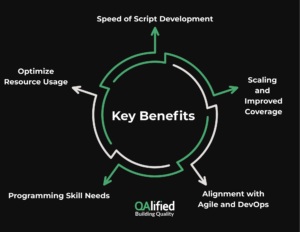
The implementation of codeless test automation provides agile startups and their fast-growing teams with multiple advantages. The following points outline the main advantages of codeless test automation.
1. Speed of Script Development: Teams can create test cases faster because no custom scripting is required. What earlier took days can now be completed in a few hours. The shorter feedback cycle allows teams to check their features before the development process reaches its end.
2. Eliminates the need for Programming Skills: The codeless tools allow users without programming skills to create tests because they do not require any scripting knowledge. This enables non-technical users to create automated tests without programming experience. The increased number of contributors helps teams overcome testing bottlenecks, which allows them to execute multiple test automation tasks simultaneously.
3. Optimize Resource Usage: Startups can optimize their resource usage to achieve better cost efficiency through the deployment of codeless automation tools. By increasing the productivity of automation script development and by eliminating the need for hiring SDET’s the cost of automation testing is reduced.
4. Alignment with Agile and DevOps: The automated testing process using codeless approaches helps organizations maintain better alignment with their Agile and DevOps practices. The visual structure of tests along with their modular design structure, allows teams to execute fast iterations.
5. Scaling and Improved Coverage: The right deployment of codeless platforms allows teams to scale their activities through reusable components, visual libraries, and templates. The implementation of codeless automation in startup and scaling teams produces four main advantages, which include:
- Fast release cycles become possible once QA bottlenecks are removed.
- The testing process becomes accessible to all team members.
- The automated test coverage can be increased at a faster pace because of shorter waiting times.
- QA teams can focus on developing new features because manual regression testing has been eliminated.
The advantages of codeless test automation exist, but teams need to understand its inherent limitations and common challenges.
Common Challenges & Limitations: What to Watch Out For?
Vendor Lock-in: The use of proprietary frameworks in codeless tools creates vendor lock-in situations for users. The process of switching to a different tool becomes expensive and complicated.
Limited Flexibility: The testing of complex systems with multiple APIs, complex user interfaces, and non-standard user interface elements becomes challenging for codeless tools. The process of automating complex scenarios becomes more challenging when testing tools do not support scripting or programming capabilities. Teams encounter roadblocks that slow down progress and reduce test coverage because they cannot code around the tool limitations.
Maintenance Overhead: Codeless tests still require regular maintenance, just like traditional automation. The automation pack requires periodic updates because UI elements change and operational paths shift, and environmental conditions evolve. This can be overcome by selecting a codeless test automation platform with self-healing capabilities.
Scalability & Integration: Scaling automation becomes difficult when multiple teams and applications operate across different platforms. When CI/CD, version control, or test data management are missing, integration quickly becomes slow and difficult.
Hidden Learning Curve: Eliminating scripting does not eliminate the need for learning the capabilities of the codeless automation tool. Users must still understand test logic, element selection, flow control, and tool-specific behavior to build reliable automation tests.
How to Adopt Codeless Test Automation in Your Team
The following structured adoption plan shows how agile startups and scaling teams can implement codeless automation.
Step 1 – Define Scope and Objectives
- The first step requires selecting test scenarios for automation, starting with smoke tests, regression flows, and core business paths.
- The team should set clear targets, such as cutting manual regression by 50 percent within three sprints.
- The team needs to determine their current skill levels and tooling requirements.
Step 2 – Select the Right Tool
- The evaluation process for vendor maturity, feature sets, and integration capabilities with CI/CD, version control, and environment support should be completed.
- The organization needs to understand licensing terms and evaluate potential vendors lock-in risks and support options.
- The tool needs to undergo a small-scale pilot test on a single module to confirm its compatibility.
Step 3 – Build Initial Framework & Components
- The development process requires creating reusable modules and components, which include login flow and navigation steps.
- The team needs to establish naming conventions, common libraries, and standardized templates for their work.
- The tool’s interface and operational logic require business users/testers to receive training about its functionality.
Step 4 – Integrate into CI/CD Pipeline
- The automated test suite needs to be executed during pull request builds and nightly regression jobs.
- The tool needs to display test results through reports that show test success, failure status, and identify unstable tests.
- The test feedback should connect to sprint review and retrospective metrics for better analysis.
Step 5 – Scale Across Teams & Releases
- The automation scope should expand through controlled stages, which include mobile testing, API, and cross-browser testing.
- Business testers and product owners should receive training to create tests as part of their responsibilities.
- The team needs to work with the tool vendor to include additional features in the roadmap and to find solutions to the tool limitations.
Step 6 – Measure ROI and Adjust
- The team should track three essential performance indicators, which include automated versus manual work duration. test failure rates and release duration.
- The application teams should be trained to execute and maintain the automation tests rather than having a dedicated test automation team.
This approach embeds codeless automation directly into the Agile delivery cycle rather than treating it as a separate activity.
Best Practices & Tips for Scaling Your Codeless Test Suite
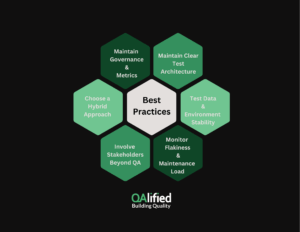
Test automation at scale within agile and growth organizations needs both proper tools, established discipline, and strategic planning. The following best practices focus on codeless automation testing methods.
Maintain Clear Test Architecture
- The test organization should establish test categories that include smoke tests, API tests, regression tests, and end-to-end tests.
- The development of independent test automation should focus on creating independent tests that perform idempotent operations and can be used multiple times.
- The development process should create separate test components instead of building extensive single test execution sequences.
Focus on Test Data & Environment Stability
- The use of synthetic or anonymized production data sets helps prevent data drift from occurring.
- The testing environment needs to maintain identical conditions for all test execution runs, which should include staging and production environments.
- Perform automatic environment resets when possible.
Monitor Flakiness and Maintenance Load
- The team needs to track test failure occurrences that stem from tool problems, UI modifications, and environmental instability.
- The process of removing outdated tests should occur during scheduled maintenance periods.
- The process of removing unnecessary test flows should be actively promoted throughout the organization.
Involve Stakeholders Beyond QA
- Include business analysts and product owners who can create tests and verify their accuracy.
- The team should provide test coverage and status reports that non-technical staff members can access through dashboards.
- The testing process should unite developers with the QA and operations team and business experts for better collaboration.
Choose a Hybrid Approach When Needed
- Teams may require a hybrid solution when standard codeless tools prove insufficient for specific testing needs.
- A combination of codeless automation with scripted automation because codeless tools work best for regular processes, but specialized tests need custom scripting.
- The tool must provide users with the ability to switch to custom scripting or extend its functionality.
Maintain Governance and Metrics
Define metrics related to benefits achieved in terms of cost, quality, and test cycle time. A few examples are below:
- Percentage reduction in manual regression
- Build-to-release cycle time.
- Automation pass rate stability
- Maintenance effort per sprint
- Keep the leadership team informed on the progress and gather feedback regularly.
- Use dashboards to report automation status in real time.
By applying these practices, one can avoid common scaling problems and ensure that codeless automation remains a strategic asset rather than a liability.
Conclusion: Try QAlified’s Solution for Codeless Testing
A well-designed test automation approach serves as the foundation for maintaining development speed when organizations use Agile, AI, and DevOps practices. Codeless test automation provides agile startups and scaling teams with speed, team involvement, and agility, which represent major benefits. The implementation of codeless automation requires organizations to develop strategic plans and maintain disciplined scaling methods and appropriate tool selection.
QAlified enables teams to advance their test automation capabilities past fundamental codeless testing capabilities. The platform provides an automated testing solution that maintains pipeline speed and minimizes maintenance work while adapting to complex real-world testing requirements. Business testers and QA engineers collaborate through visual test design while maintaining their ability to create custom automation solutions for complex testing needs.
Book a demo to see how your team can cut down manual regression effort, accelerate releases, and maintain high quality with significantly reduced test code.
SHARE:

