


The deployment of Large Language Models (LLMs) in industries faces challenges because current evaluation methods do not effectively identify harmful output results.
Organizations can achieve the following objectives through the evaluation of LLMs using particular assessment metrics.

Why Evaluating LLMs Matters
The deployment of Large Language Models (LLMs) in industries faces challenges because current evaluation methods do not effectively identify harmful output results. Organizations can achieve the following objectives through the evaluation of LLMs using particular assessment metrics.
- The system produces exact solutions which fulfils requirements for different operational needs.
- Organizations will obtain their best AI investment returns through continuous model performance monitoring.
- Decreases both hallucinations and the spread of false information.
- Builds trust with users through its built-in bias detection and toxic content features which users must follow.
- Achieves better fine-tuning results through its feedback-based methods which enhance its performance.
- Meets enterprise standards for deployment readiness and provides users with full confidence in its operation.
Categories of LLM Evaluation Metrics
The evaluation technique landscape needs complete understanding. The fundamental evaluation categories include:
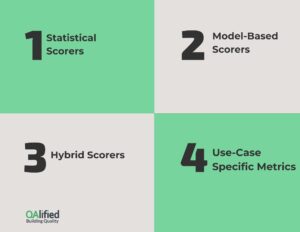
1. Statistical Scorers
The evaluation process of model outputs against reference texts uses token overlap analysis through BLEU and ROUGE and METEOR metrics. The evaluation method demonstrates its best performance when used for translation and summarisation work but it does not succeed in assessing open-ended responses.
2. Model-Based Scorers
Large models function as judges to evaluate quality aspects which include coherence and factuality and relevance. The evaluation tools G-Eval and Prometheus use human-like scoring methods because of their assessment approaches.
3. Hybrid Scorers
This method generates evaluations through the combination of statistical analysis with semantic understanding. The platforms allows users to evaluate creative content and factual information through its GPTScore and QAG Score assessment tools. Artificial QA is a practical example of a hybrid scorer, blending traditional evaluation signals with AI-driven judgment to assess real-world, open-ended responses
4. Use-Case Specific Metrics
This method includes metrics which focus on RAG operations and summarisation and code production tasks. The evaluation method checks output source links to ensure both their accuracy and safety.
Core Metrics You Should Know
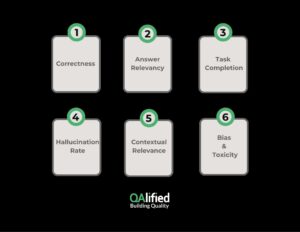
1. Correctness
- The metric evaluates how well the model produces responses which match actual facts from verified sources and real-world evidence.
- Verifies that all generated content aligns with reliable reference materials which include policy documents and medical guidelines and legal statutes and academic content.
- Functions as a vital component which protects high-risk areas including healthcare and law and finance and education because any minor mistake would result in dangerous outcomes.
- Enables teams to track the frequency at which their model generates proven facts instead of baseless assumptions.
- Develops enduring user trust because people need AI to help them make decisions and learn new things.
2. Answer Relevancy
- The metric evaluates the extent to which the model-generated response matches the original user query.
- The output maintains direct focus on the prompt requirements by avoiding any unnecessary details which are not relevant to the task.
- Requires high accuracy because it serves chatbots and virtual assistants and customer service platforms which depend on exact results to deliver positive user experiences.
- Enables users to detect when the model fails to understand user input correctly and where the model produces incorrect results during prompt interpretation.
- Enhances user interactions through its ability to reduce the number of additional questions which stem from ambiguous or irrelevant answers.
3. Task Completion
- The metric checks if the model finishes its assigned work and fulfils all conditions that were specified in the task.
- Checks that all essential steps in tasks including booking and summarising and classification and data extraction get performed accurately.
- The review process verifies that all output elements match the specified format while maintaining correct structure and business rules which include all required sections.
- The model produces incomplete answers in specific areas which need to be addressed.
- Enables automation operations which require complete task reliability for their execution.
4. Hallucination Rate
- The metric measures the frequency at which the model produces made-up or unverified data.
- Detects instances when the model displays absolute certainty about false information which it presents as accurate.
- Enables organizations to measure trust-related knowledge risks which appear in their applications.
- Enables ongoing optimization through its ability to show the most common locations where hallucinations take place. For example a high hallucination rate in AI in Test Automation can lead to invalid locators, fake APIs, or incorrect assertions which directly impact test reliability.
- The accuracy of data directly affects how others view our credibility because it affects research findings and news reports and financial data and business decision-making systems.
- Contextual Relevance (RAG)
- The metric evaluates whether the obtained documents actually validate the information which the system produced.
- The model uses the knowledge base to generate its responses instead of depending solely on its general training information.
- The response requires documentation validation through which all referenced materials must prove the statements presented in the answer.
- Enables users to identify retrieval errors which produce incorrect search results.
- Enhances user confidence when using enterprise search functionality together with internal knowledge bots and systems that follow compliance regulations.
6. Bias and Toxicity
- The assessment of this metric determines if the output contains any dangerous or discriminatory or harmful language.
- Identifies content which promotes discriminatory behaviour toward people because of their gender or race or religion or age or their background.
- Enables businesses to maintain their commitment to ethical AI guidelines and workplace security protocols.
- Enables organizations to maintain regulatory and legal standards which protect their operations in industries that require special attention.
- Protects brand reputation together with user trust because it stops users from creating dangerous content.
How to Design an Evaluation Pipeline
The development of an LLM evaluation pipeline needs careful planning and automated processes which should serve purposes that match actual operational needs. The following steps will help you create an effective solution.
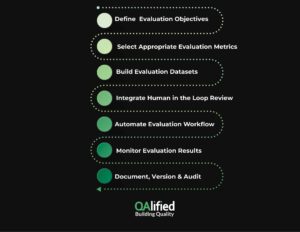
1.Define Clear Evaluation Objectives
The main objective of your evaluation needs to be identified as either factual accuracy or safety or user satisfaction or task success. The selection of metrics and rubrics depends on the specific task you are performing between summarisation, Q&A, code generation, RAG and chatbot interactions.
2. Select Appropriate Evaluation Metrics
The evaluation process should use three different types of assessment which include statistical measures such as BLEU and ROUGE and model-based assessments like G-Eval and GPTScore and specialised metrics for specific domains. The selection of metrics should focus on user intentions and actual success rates instead of using token comparison as the primary evaluation method.
3. Build Evaluation Datasets
The testing approach should include three different types of input which combine actual user search terms with artificially generated test data and situations that represent the outer limits of system operation. One needs to generate golden datasets which include reference outputs for automated scoring purposes. It is key to establish a feedback system which will maintain the evaluation sets through ongoing updates.
4. Integrate Human-in-the-Loop Review
The validation process requires SMEs or human annotators to check both complex scenarios and dangerous system outputs and boundary situations. This requires benchmarking automated metrics against human judgments to verify its reliability. The process should include steps to record personal assessment ratings which include tone and helpfulness through survey instruments and rating systems.
5. Automate Evaluation Workflow
The evaluation process should use platforms like DeepEval and TruLens platforms for its operationalisation. The evaluation process should be integrated into model training and fine-tuning operations and CI/CD workflows.The evaluation process should start with offline pre-deployment assessment followed by online post-deployment assessment.
6. Monitor Evaluation Results Over Time
The process needs to include steps that will capture performance baselines for metric tracking of all changes that occur in the system. Also the trends needs to be visualised using dashboards. The team should use alerts together with thresholds to detect when performance degrades or when system behaviour becomes abnormal.
7. Document, Version, and Audit
It is key to ensure that users are maintaining complete records which should include test data version history , scoring rubrics and evaluation logic modification records. The implementation of version-controlled pipelines serves to achieve reproducibility in the system. Organizations should distribute clear reports to their stakeholders and auditors who need access to this information particularly when operating under regulatory requirements.
Teams can create scalable LLM evaluation pipelines through these steps which will lead to safer and more effective deployments.
Best Practices & Pitfalls to Avoid
Best Practices
- The assessment should combine quantitative data with qualitative performance indicators which measure both system accuracy and user contentment.
- Perform ongoing evaluation procedures which should take place after model updates and retraining and fine-tuning operations to identify performance deterioration at its beginning.
- The evaluation standards need to match the specific requirements of your industry together with your regulatory situation and your organisational values.
- The evaluation process requires all evaluators to receive identical training which will help them maintain consistent evaluation methods.
- Focus on explainability because it needs tools which show the reasoning process behind score calculations to enable output debugging and enhancement.
- The evaluation process requires researchers to measure their models against established top-performing systems which serve as reference points.
- The evaluation strategy should use user behaviour analytics to study how users interact with model output results for developing assessment methods which go past traditional numerical metrics.
Common Pitfalls
- The current practice of depending on outdated evaluation metrics including BLEU and ROUGE presents a major issue because these metrics do not measure semantic accuracy or user intent.
- The evaluation process becomes ineffective when researchers analyze model results independently from both environmental factors and retrieval performance data which RAG systems generate.
- The system fails to process user logs and production performance data which results in missing actual problems that occur in real-world operations.
- The evaluation set needs to change its composition because static datasets become ineffective for ongoing assessment.
- The process of robust evaluation needs more than one attempt because it requires both time and specialised tools and qualified experts to complete.
Trends & Advances in LLM Evaluation
The LLM evaluation landscape is evolving rapidly. Here are key trends shaping the space in 2026:-
- The practice of using LLMs as judges has started to gain popularity because businesses now depend on these models to assess output quality based on three criteria which include relevance, helpfulness and style. These judges achieve better results than static metrics when evaluating subjective content.
- The evaluation process now operates in real-time because streaming evaluation tools continuously monitor production outputs to detect any irregularities.
- The development of new evaluation methods for multimodal systems has become necessary because multimodal models continue to advance in their field.
- The current tools automatically produce various test cases which include adversarial and rare scenarios to test models at their limits and detect their critical points.
- The core element of evaluation platforms now includes explainability because they use rationale generation and scoring explainability to establish trust relationships with developers and auditors.
- Bias and fairness operate as fundamental evaluation criteria which organizations use to detect and reduce discriminatory content and offensive material.
- Healthcare and legal and finance teams now use customised scoring systems which they developed to meet their specific compliance and quality requirements.
- The evaluation tools for LLMs now provide direct integration with MLOps systems and data monitoring platforms which enables organizations to maintain a continuous production feedback system.
How QAlified Helps You Benchmark & Monitor LLMs
As LLMs become core components of enterprise systems, evaluation metrics are no longer optional—they are critical. They enable organizations to move beyond experimentation and confidently deploy AI systems that are accurate, reliable, compliant, and aligned with real business needs.
A robust LLM evaluation strategy helps teams:
- Detect and reduce hallucinations before they reach production
- Ensure relevance, correctness, and task completion at scale
- Monitor bias, toxicity, and compliance risks
- Continuously improve performance through feedback-driven optimization
However, designing and maintaining effective evaluation pipelines requires more than isolated metrics. It demands expertise, automation, and continuous monitoring across the full AI lifecycle.
That’s where QAlified comes in.
QAlified enables:
- Fast setup of custom evaluation pipelines.
- Dashboards and alerts for production monitoring.
- Built-in metrics + ability to define your own.
- Seamless integration with LLM workflows.
Discover how QAlified can help you evaluate, optimize, and scale your LLM solutions safely and effectively.
SHARE:

