


Behavior-Driven Development (BDD) serves as an effective testing practice while simultaneously functioning as a strong tool for cross-functional team collaboration.
The development process connects business requirements to technical development through the conversion of behavior specifications into executable tests. The approach minimizes team confusion while accelerating testing to guarantee software accuracy for user requirements.

Recent industry reports underscore its growing impact. The 2025 State of Continuous Testing Report by Perforce shows that BDD adoption has reached 66% among teams while 58% of these teams also practice Test-Driven Development (TDD) to enhance test alignment and coverage. The World Quality Report 2024–25 indicates that 63% of organizations view BDD or TDD as fundamental tools for Agile teams to produce higher quality software at pace.
This article presents a BDD framework overview followed by a workflow explanation, TDD comparison and addresses typical challenges with their solutions.
How Behaviour-Driven Development Works
BDD uses Gherkin to define features through behavior scenarios, which are written in non-technical plain language.
Login Example Using Gherkin:
Feature: User login
Scenario: Valid credentials
Given Alice is on the login page
When she enters valid credentials
Then she should be directed to her dashboard
The human-readable scenarios function as living documentation which enables developers and QA teams and business stakeholders to share understanding and usage. A BDD framework dedicated to Cucumber translates feature files into automation code before running complete end-to-end tests.
What is a BDD framework and How it Works?
A BDD framework such as Cucumber, SpecFlow or Behat links natural language scenarios to executable automation:
- Feature files capture behavior.
- Step definitions link steps to automation code (UI, API, or backend).
- The BDD runner executes scenarios, reporting pass/fail results in business terms.
With “Selenium Automation Template with Cucumber”, QAlified combines reusable step libraries and clear documentation. Teams adopting this template accelerated onboarding, allowing both technical and non-technical users to write and run tests within days.
Key Benefits of Behavior-Driven Development
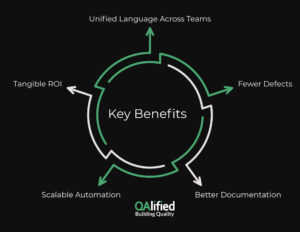
1.Unified Language Across Teams:
- BDD uses Gherkin scenarios written in plain English to describe software behavior.
The use of plain English in Gherkin scenarios enables developers, testers, and business users to understand requirements easily, which minimizes initial misunderstandings and ensures everyone has aligned expectations.
2. Fewer Defects
- According to Cucumber survey results, BDD teams deploy twice as often as average teams.
- The teams identify misunderstandings and test coverage gaps early, which helps prevent defects before release.
3. Better Documentation
- Feature files function as both automated tests and living documentation.
- The product maintains its relevance through feature files because traditional documentation tends to become outdated.
4. Scalable Automation
- BDD enables teams to develop reusable steps between UI and API layers.
- It enables CI/CD pipelines to execute hundreds of automated scenarios directly linked to business outcomes.
5. Tangible ROI
- Combining BDD with Agile methods results in fewer bugs during late development stages and reduced rework expenses.
- The method connects technical work with business objectives, which enhances testing speed and team productivity.
BDD Workflow: From Requirements to Automation
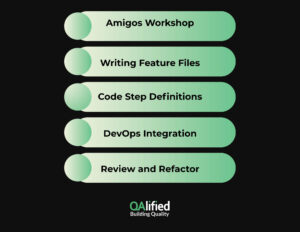
1. Amigos Workshop:
- The Three Amigos workshops are the initial step in which business analysts join forces with developers and QA engineers
- The team translates user stories into specific examples of desired system behavior. Collaborative meetings enable teams to establish common understanding while minimizing confusion
- Reveals hidden boundary conditions before beginning development work.
2. Writing Feature Files:
- Teams collaboratively write feature files using Gherkin syntax, based on the examples discussed during the Amigos workshop.
- The business rules are expressed through Given-When-Then scenarios in each scenario.
- Achieves clarity because all stakeholders, including non-technical ones, should grasp what the system needs to accomplish.
3. Code Step Definitions:
- Developers and QA automation engineers write code that establishes connections between Gherkin steps and automation scripts.
- Use a shared step library to enable reuse while minimizing duplication and sustaining project consistency.
4. DevOps Integration:
- BDD tests run automatically through the continuous integration (CI) pipeline.
- Cucumber framework produces detailed reports (HTML, JSON, JUnit), which allow teams to detect regressions and monitor test coverage effectively.
- Integration of tools such as Jenkins, GitHub Actions, and Azure DevOps provides automated testing.
5. Review and Refactor:
- The application’s evolution requires corresponding test changes.
- Teams perform periodic assessments of feature files and step definitions to eliminate repetitive code, adjust to changing requirements, and optimize their processes.
- The BDD suite maintains its value and business relevance through continuous maintenance activities.
Most Used Tools and Frameworks in BDD
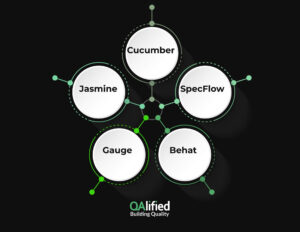
1. Cucumber:
- It is a leading BDD tool that supports Java, JavaScript, and .NET programming languages.
- The tool reads Gherkin feature files to link them with automation code.
- Provides extensive plugin capabilities for CI/CD tools and test reporting features.
- Many teams automate with Selenium and Cucumber to execute behavior scenarios as real browser tests which verify that UI functionality matches user expectations.
2. SpecFlow:
- The .NET-based BDD tool, SpecFlow integrates directly with Visual Studio as its primary development environment.
- Allows developers to write C# code, which is then mapped to Gherkin scenarios.
- The combination of test runners, including NUnit and xUnit, along with seamless CI integration, makes SpecFlow the preferred framework for Microsoft-based teams.
3. Behat:
- This PHP-based BDD tool specializes in testing web application behavior.
- Uses Gherkin syntax to automate browser testing through Mink and Selenium tools.
- It is a popular testing solution for PHP developers who work with Drupal and Symfony platforms.
- The tool’s natural language approach enables business stakeholders to understand its functionality.
4. Gauge:
- The tool represents a lightweight BDD framework developed by Thoughtworks, which supports Java, C#, and JavaScript programming languages.
- Uses markdown syntax for writing test cases and enables users to perform modular data-driven testing.
- Supports parallel execution and offers a rich plugin architecture which makes it suitable for microservices environments and teams using different technology stacks.
5. Jasmine:
- The framework helps with BDD-based testing and specializes in JavaScript unit testing for front-end development.
- The testing framework operates independently from external libraries and integrates perfectly with Karma and Protractor tools.
- The syntax of Jasmine provides an intuitive interface which makes it suitable for test-driven UI development within Angular and other modern JavaScript frameworks.
BDD vs TDD: Similarities and Differences
BDD (Behavior-Driven Development) and TDD (Test-Driven Development) share the goal of enhancing code quality and minimizing bugs during the initial stages of development. The two approaches share a test-first approach yet follow distinct methods to achieve this goal. BDD begins its process by focusing on user behavior expectations before moving to code-level testing, whereas TDD starts with code-level testing. Teams must understand the commonalities and differences between these approaches to select the best method or combine them properly.
| Aspect | TDD | BDD |
| Focus | Code correctness | Behavior & business flow |
| Language | Developer-centric | Business-readable (Gherkin) |
| Participants | Developers | Dev, QA, and Business stakeholders |
| Scope | Unit tests | Acceptance/system-level tests |
| Output | Code quality and design | User-valuable behavior delivery |
Common Challenges and Fixes

1. Step Duplication & Over-Specification
The maintenance overhead increases because teams duplicate their steps while making minimal changes. When steps maintain direct connections to UI components the system becomes more fragile and harder to maintain. Implementing shared step libraries together with background sections and scenario outlines should achieve the standardization of definitions.
2. Lack of Collaboration in Scenario Authoring
Writing feature files typically remains within the domain of testers or developers without business stakeholder involvement. The Three Amigos method enables teams to create scenarios together. Workshops allow stakeholders to validate behavior through validation activities.
3. Poor CI/CD Integration
BDD scenarios fail to connect correctly with the CI/CD pipeline, resulting in delayed feedback. Cucumber/SpecFlow reports should be set up in HTML/JSON format and linked to Jenkins, GitHub Actions, and Azure Pipelines.
4. Inconsistent Step Naming & Organization
The execution of large BDD suites produces delayed feedback which results in delayed test results. The solution requires standard naming conventions and domain-based categorization with monthly auditing.
5. Slow Test Execution
The extensive nature of BDD suites produces extended feedback delays. The solution involves using metrics to detect slow steps followed by parallel execution and service mocking.
Emerging Trends around Behavior-Driven Development:
BDD has moved past test automation because current trends demonstrate its influence on collaboration and AI testing and enterprise quality practices.
The following features are available in Cucumber Studio 3.0:
- AI-Powered BDD Authoring: Tools like Cucumber Studio 3.0 suggest Gherkin scenarios from user stories.
- Smart Step Libraries: Auto-suggest reusable steps across teams.
- Multi-platform CI Integration: Native plugins for GitHub Actions, Jenkins, and GitLab CI.
- Behavior Analytics: Heatmaps of step usage and flakiness rates to optimize testing effort.
Best Practices to Implement BDD in your Team
1- Amigos Workshops: The Three Amigos workshops need to run according to a schedule to detect behavior problems at their early stages. These sessions unite developers, testers, and product owners to create scenarios together. The process ensures everyone shares the same understanding while revealing edge cases early, thus reducing the need for additional work.
2- Step Libraries: A shared step library containing everyday actions should be developed to prevent duplication and maintain team consistency. A well-organized library of generic steps boosts reusability, speeds up test writing, and simplifies maintenance.
3- Modular Test Suite: Modularity improves with tags and outlines. Tag your scenarios with types (e.g., @smoke, @regression) and implement outlines for data-driven tests. The execution speed increases while critical test paths become easier to prioritize.
4- DevOps Integration: BDD scenarios should be integrated into CI/CD pipelines to run tests on every commit while providing fast failure detection for behavioral regressions. Fast feedback lets teams quickly detect bugs while building confidence in continuous delivery.
5- Monthly Reviews: Every month, a review process should examine scenarios and performance. The scheduled audits help eliminate outdated tests while detecting flaky steps and maintaining feature alignment. This process improves execution speed and test suite reliability.
6- Training: All roles, including business users and developers, need training to develop their skills in Gherkin writing, feature file understanding, and result interpretation. Training promotes team collaboration while enabling more team members to create tests.
7- Reporting dashboards: Dashboards should be used for maximum effect. Allure and Cucumber reports enable you to visualize test results. The dashboards improve visibility, which allows better results in communication with stakeholders and behavioral trend monitoring.
A QAlified client achieved a 30% reduction in their automation maintenance costs through:
- QAlified team performed monthly assessments of its features and step libraries.
- The process included duplicate removal followed by behavior refactoring.
- The team applied tagging to CI runs to select specific relevant scenarios.
The test suite became more efficient while providing quicker feedback loops.
FAQ’s on BDD Framework
- 1. What is meant by behavior-driven development?
Behavior-driven development (BDD) enables teams to use simple language scenarios to define software behavior during collaborative development. The automated process verifies that behavior remains consistent. The approach allows for shared understanding and continuous validation through automated testing practices. - 2. How is BDD different from traditional testing?
The traditional testing approach occurs after development completion and mainly aims to detect defects. BDD begins with behavior definition before development to guarantee the team creates the correct product. The method promotes simultaneous work between teams and ongoing verification processes. - 3. What is BDD vs Cucumber?
BDD is a methodology, while Cucumber is a tool that implements BDD. BDD represents a methodology, but Cucumber is the tool that puts BDD into practice. The Gherkin scenarios serve as input for Cucumber, which generates automation code to transform human-readable text into executable tests. - 4. Which BDD framework is best?
The selection depends on your current technology framework. Cucumber is a popular tool that supports Java, JS, and Ruby programming languages. The .NET platform benefits the most from SpecFlow, its ideal tool. Gauge and Behave are suitable options because of their flexibility and extensibility features. Select the tool according to the programming languages you use and the strength of the supporting community. - 5. What are the three principles of BDD?
- Shared understanding through collaboration.
- Use of ubiquitous language to describe behavior.
- Specification of behavior using examples.
- 6. What does BDD mean in Agile?
BDD supports Agile principles by providing quick feedback, promoting team understanding, and delivering work in small increments. It integrates well with Agile ceremonies through sprint planning, verifying that acceptance criteria match the defined stories. - 7. What is BDD vs TDD?
TDD requires developers to write unit tests for code correctness before starting implementation. BDD extends this approach by using Gherkin scenarios to test external behavior. BDD combines extensive collaboration with higher-level testing approaches. - 8. What is BDD in Selenium?
Selenium BDD automation uses Selenium WebDriver together with BDD tools, including Cucumber, to test UI components. Scenarios written in plain text describe user interactions, while step definitions operate as Selenium action controllers. - 9. Which tool is used for BDD?
The most used BDD tools include Cucumber, SpecFlow, Behat, Gauge, and Jasmine. Cucumber’s automation framework integration capabilities make it the most popular choice for multiple programming languages.
- 10. Why is BDD Important in Agile Development?
BDD strengthens Agile by integrating team collaboration directly into the development workflow. The method decreases confusion between team members while maintaining business requirement compliance through automated verification processes.
Conclusion: Why you should consider BDD in your QA processes
BDD transforms QA into a trusted partner by integrating quality checks directly into the software development lifecycle. The combination of collaborative scenario writing with automated living documentation and business-focused validation enables teams to maintain alignment while releasing confidently. QAlified has assisted various clients in the financial and retail sectors in developing strong BDD strategies, which decreased defects, accelerated deployments, and strengthened stakeholder trust.
QAlified provides customized BDD frameworks together with training and expert consulting services to transform your QA function into a business value generator.
Talk to us now and start your BDD journey with confidence.
SHARE:

