


ERP systems coordinate the fundamental business processes through tightly integrated modules, based on common data models, workflow engines, and transactional consistency in distributed settings.
These systems are connected to outside APIs, legacy systems, and live data streams, and are therefore vulnerable to schema changes, dependency breakdowns, and configuration drift. This is the reason why ERP testing is so necessary.
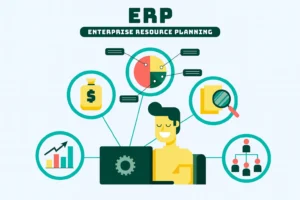
ERP testing checks process integrity end-to-end, data consistency, and system behavior under load, concurrency, and failover. It prevents breaking transactional accuracy, authorization logic, and integration points across the enterprise stack by customizations, extensions, and patches.
This blog explains what ERP testing is and how it verifies process orchestration, data integrity, and system resilience within complex and integrated enterprise landscapes.
We will discuss the main types of tests, the execution methodology of QAlified, practical advantages, pitfalls, effective mitigation strategies, and a short FAQ of ERP QA teams.
What is ERP testing?
ERP testing is an organized validation procedure that verifies the stability, accuracy, and performance of enterprise resource planning systems within integrated business modules. These systems run on intricate setups, standard data models, and interconnected reasoning in finance, logistics, procurement, HR, and compliance.
The testing procedure is aimed at the functional correctness, configuration accuracy, and interface integrity within the internal workflows and external integrations. It ensures that custom code, user roles, business rules, and third-party APIs are functioning as expected in production-like environments.
The test environments should simulate the real data volumes, concurrency levels, and dependency chains to identify defects early in the SDLC. ERP testing is crucial in the first deployments, version upgrades, and post-customization testing. It avoids regression failures, data corruption, and orchestration failures in distributed components.
Types of ERP Tests
The scale and complexity of ERP platforms necessitate a variety of tests to ensure all facets of the system operate as intended. All the types of tests are aimed at various aspects of the quality of the ERP.
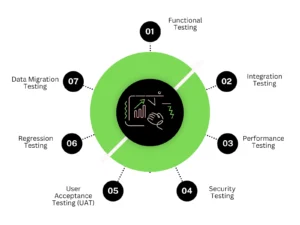
Let’s have a look at the different types of ERP testing:
- Functional Testing: This type of testing ensures every module and feature of the ERP is functioning as per the requirements and design. It guarantees that all business processes (e.g. finance postings, HR onboarding workflow, order processing) will work properly following any customizations.
- Integration Testing: Testing the compatibility of the different modules and third-party applications integrated with the ERP. During integration testing, testers ensure that end-to-end business process flows through the ERP. For example, an order entry in the sales module flows through to the inventory and billing modules correctly.
- Performance Testing: The actual testing of the ERP system under the real workloads. This involves simulating a large number of users and transaction loads to ensure that the ERP can handle peak usage periods without performance issues or failures.
- Security Testing: As ERPs store sensitive data (financial records, employee data, customer info, etc.), security testing is essential. This involves checking user role privileges, data encryption, and vulnerability testing to see how users can gain unauthorized access to the data or breach it.
- User Acceptance Testing (UAT): In UAT, real users of the ERP system do the testing to ensure that the system can satisfy their requirements in a real situation. It aids in identifying problems that only actual users would recognize and ensures that users are on board with it. Once users sign off on the system during UAT, it increases the adoption rates after the launch.
- Regression Testing: Regression tests are re-executing test cases that have passed earlier, once a new module is added or a patch is installed. This makes sure that new changes do not break old functionality. Frequent regression testing identifies unintended side effects early and keeps the overall stability of the ERP intact in the long term.
- Data Migration Testing: Migration testing usually entails reconciliation between the old and new systems and verification of any data loss or discrepancies. It is an important single test during implementation to avoid big data problems post-cutover.
What are the ways of running ERP tests in QAlified?
The ERP testing methodology at QAlified is systematic and based on experience with enterprise systems. We aim to achieve quality, speed, and risk reduction at each stage. This is our general process of ERP testing with a client:
Planning & Strategy
The first step is to research the scope of the ERP implementation and the business processes of the client. This includes the listing of all the ERP modules, integrations, and key workflows that should be validated.
A detailed test plan and strategy describe the scope of testing, the kind of tests required, the roles and responsibilities, schedules, and areas of risk. Planning in advance will help to have a proper roadmap, and testing should be in line with the goals and compliance requirements of the organization.
Test Design and Preparation
The testing team develops detailed test cases using ERP requirements and company’s use cases. Test data is generated, along with test cases, to create realistic conditions, such as creating sample datasets or extracting anonymized real data.
Environment Setup
This involves setting up the ERP application, databases, and other integrated systems (CRM, e-commerce, etc.) in an isolated environment. All modules are installed, setup, user accounts created, privileges assigned, and sample data loaded.
It is common to have test environments provisioned and scaled quickly using virtualization or cloud-based environments.
Functional and Integration Testing
Once the environment is prepared, the team performs functional tests of each ERP module and integration tests of cross-module workflows. These tests systematically verify that all functions and end-to-end processes are functioning as expected.
At this point, we use a combination of manual and automated test scripts. During this step, any defects or deviations are noted.
Performance and Security Testing
Simultaneously with the functional testing, specific non-functional tests are also conducted. To test performance, teams at QAlified employ tools to emulate large numbers of concurrent users and high transaction volumes to see how the ERP behaves under stress.
This includes tracking response time, throughput, and system resource consumption to find out any performance bottlenecks or slow queries. Stress tests load the system beyond normal to observe degradation, ensuring graceful failure without data loss.
In security testing, we evaluate user rights, potential misuse, and data security, such as preventing Department A users from accessing Department B’s confidential data.
Defect Resolution and Regression
As we find defects during testing, we log them in a tracking system with step-by-step replication instructions. We collaborate with the client’s implementation/development team to address each issue as quickly as possible.
After the fixes are implemented in the ERP, testers re-test the functionality to ensure that the defect has been fixed. We also conduct regression tests periodically, rerunning a set of core test cases (including those that had passed earlier) to ensure that new changes have not introduced any regressions.
User Acceptance Testing (UAT)
Different real time scenarios are provided to key users of various business units (finance, HR, sales, etc.) to perform in the ERP that correspond to their day-to-day work.
In UAT, our QAlified team assists the users, gets their feedback, and records any usability issues or last-mile configuration adjustments that could be required. UAT is crucial for achieving user buy-in. When users confirm that the system works in their favor and is easy to use, it significantly instills confidence in the ERP.
Reporting & Handover
Upon the completion of the testing, a comprehensive test report and documentation are prepared. This contains the results of the tests run, defect lists, performance benchmark results, and a report of the overall system readiness.
By this point, the project team and stakeholders have a clear view of the quality of the ERP. QAlified may also be involved in maintenance testing, even after go-live. For example, re-testing after new updates or the inclusion of new features, to keep the ERP reliable throughout its life cycle.
Benefits of running these tests
Spending time and effort on ERP testing pays off for the organization. The key advantages of thorough ERP testing are as follows:
- Facilitates Implementation: The rigorous testing ensures that the ERP system will work as expected in production, fulfilling all the business requirements before go-live. This significantly enhances the chances of a successful implementation with minimum problems, and the business can begin to realize ROI on the ERP as soon as possible.
- Avoids breakdowns and outages: Testing helps to detect bugs, configuration problems, or integration problems before they occur. Identifying these issues early is crucial to prevent costly impacts in a live system, such as crashes, errors, data loss, or security breaches that could disrupt business.
- Enhances system performance and scalability: Performance testing allows organizations to identify performance bottlenecks and streamline the performance of the ERP. Solving problems such as slow database queries or inadequate server resources before go-live means that the ERP will be capable of withstanding peak loads.
- Improves User adoption and satisfaction: A well-tested (including end-user in UAT) ERP system will be more user-friendly and reliable. Once the system is operational, users will encounter fewer bugs, misunderstandings, or missing features.
Through such benefits, ERP testing provides organizations with the assurance that it is indeed getting the full value of their ERP investment.
Challenges in ERP testing and how to overcome them
ERP projects are large and complex, which makes ERP testing very difficult. According to the experience of QAlified, the following are some of the issues that are likely to arise in ERP testing and how to address them:
- Complicated and combined system: The ERP systems are multifaceted, dynamic, and highly interrelated systems with numerous modules. The complexity is addressed by breaking testing into smaller modules and testing integrations in small steps. Repetitive tests can be consistent and covered with automation, and an iterative process enables the team to test the entire system gradually.
- Resource and time: ERP implementation schedules tend to be aggressive in terms of time and testing windows. Moreover, the testing of an ERP needs competent experts and an adequate budget, which may be limited. Start testing early in the project and consider it a central component of the implementation plan, rather than an afterthought.
- Data migration and quality: ERP may work well with static data, but it may not work with real data unless it is tested. Develop a dedicated test environment using high-quality test data. In case of data migration, do a specific migration testing to verify all records and conversions. Removing noise and loading the test system with a complete set of scenarios (typical cases, edge cases, and invalid inputs) will enhance the validity of test results.
Organizations can enhance their ERP testing by overcoming these issues before they occur. It is not only about the right test cases, but also the right strategy, tools, and team culture.
Conclusion
ERP testing forms a crucial control layer that guarantees transactional accuracy, configuration stability, integration integrity of modular, and event-driven enterprise systems.
Key takeaways:
- Adopt a risk‑based strategy covering functional, non‑functional, and data tests.
- Leverage specialized tools for transparency and efficiency.
- Engage end users early with UAT to boost adoption and minimize post-launch issues.
- Maintain continuous regression cycles to preserve system stability throughout the ERP lifecycle.
When deploying, customizing, or upgrading your ERP system, a focused partner provides traceable coverage, early identification of defects, and minimal business interruption. QAlified ERP testing uses a risk-based, structured testing approach tailored to ERP architecture, covering business logic, regression, interface certification, and performance profiling.
Contact QAlified to strengthen your ERP environment with an enterprise-level QA strategy and delivery.
FAQS
1. Why is ERP testing necessary in an integrated business environment?
ERP systems interconnect various business processes. A failure in one module can spill over to others, impacting finances, operations, and compliance throughout the organization.
2. How does ERP testing handle dynamic configurations and customizations?
Test cases are created to test business rules, custom scripts, and configuration parameters under different conditions to guarantee the predictable behavior of the system after the changes.
3. Is it possible for QA to automate everything?
Not entirely. Automation is effective in stable, repetitive processes, but complicated workflows, UI manipulation, and business validations frequently need manual interaction.
4. What are the significant dangers of omitting regression testing of ERP systems?
Failing to run regression tests can lead to unnoticed failures in dependent modules, data corruption, or workflow failures due to unseen effects of changes.
5. How do you check data consistency in the ERP testing?
Verifying data flows between modules, transaction rollback, referential integrity, and compliance with business rules under realistic loads. Data migration and integrity checks include system reconciliation, checksum validation, and validation under load conditions.
SHARE:

